Quick Answer: To measure a ceiling fan, calculate your room’s square footage to determine the ideal blade span, measure your ceiling height to select the correct mounting type (flush vs. downrod), and ensure at least 18-24 inches of horizontal clearance from walls and 7 feet of vertical clearance from the floor.
Before you commit to a new fixture, you must determine if the unit is right for your specific space. Knowing how to measure a ceiling fan involves more than just checking the width of the blades; it requires a precise look at your room dimensions, ceiling height, and the necessary clearance for safe operation. If you are currently standing in your room wondering if a specific model will fit, take a moment to grab a tape measure and a notepad. A quick assessment now prevents the frustration of an ill-fitting fan that either overwhelms the room or fails to move enough air to make a difference.
Before you dive into the technical steps, perform a quick readiness check. Ensure you have a clear, unobstructed path to the ceiling, a stable ladder, and a reliable measuring tool. If you are replacing an existing fan, consider whether the current unit’s performance was adequate; if it felt underpowered, you may need to adjust your sizing expectations rather than simply matching the old dimensions. This guide will walk you through the precise steps to ensure your next installation provides optimal air circulation and adheres to all safety standards.
Before You Start: Assessing Your Space
The most common mistake homeowners make is choosing a fan based solely on aesthetics without considering the physical constraints of the room. Before you measure anything, clear the area of furniture or obstacles that might interfere with your ability to stand directly under the mounting location. You need a clear line of sight to the center of the ceiling and enough room to extend a tape measure horizontally and vertically without obstruction.
Check your ceiling height first, as this dictates the type of mounting system you need. Standard ceilings are typically eight feet high, which allows for a flush mount or a short downrod. If your ceilings are lower than eight feet, safety regulations and manufacturer guidelines generally mandate a hugger-style fan to maintain the required distance between the floor and the blade tips. Conversely, if you have vaulted or cathedral ceilings, you will need to account for the additional length of an extended downrod to ensure the fan hangs at an effective height for air circulation.
Consider the room’s square footage as your primary guide for blade span. A fan that is too small for a large living area will struggle to create a noticeable breeze, while a massive fan in a small bedroom can create an uncomfortable, turbulent downdraft. Before you begin measuring, note the length and width of the room in feet. Multiplying these two numbers gives you the total square footage, which serves as the baseline for selecting the appropriate blade span.
Also Check: How Ceiling Fans Work?
Tools and Prerequisites for Accurate Measurement
To get accurate numbers, you need a high-quality steel tape measure that can hold its own weight when extended. Avoid using cloth tape measures, as they stretch over time and lead to significant errors in your final calculations. A step ladder is also essential, but ensure it is stable and positioned on a level surface before you climb. Never attempt to measure a ceiling fan while standing on a chair or an unstable object.
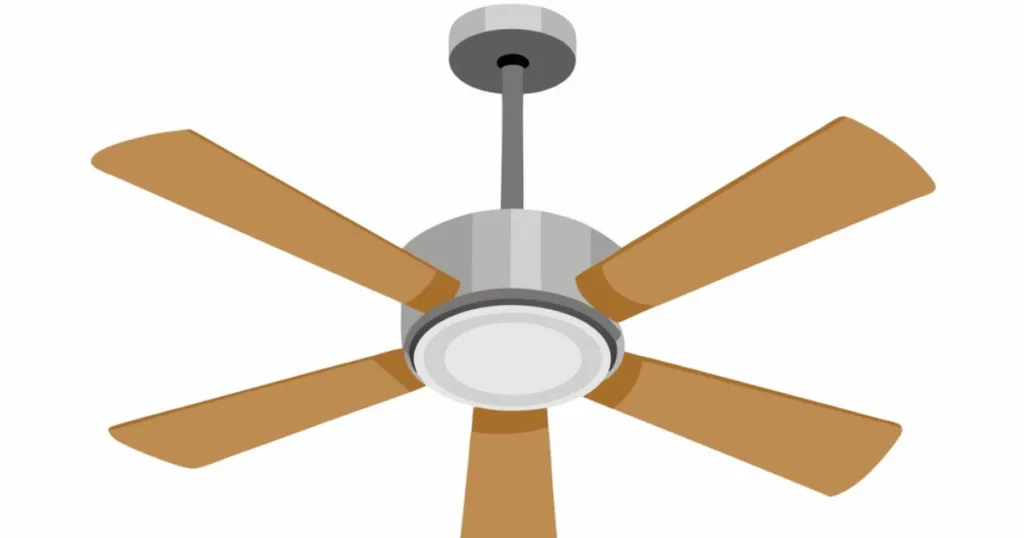
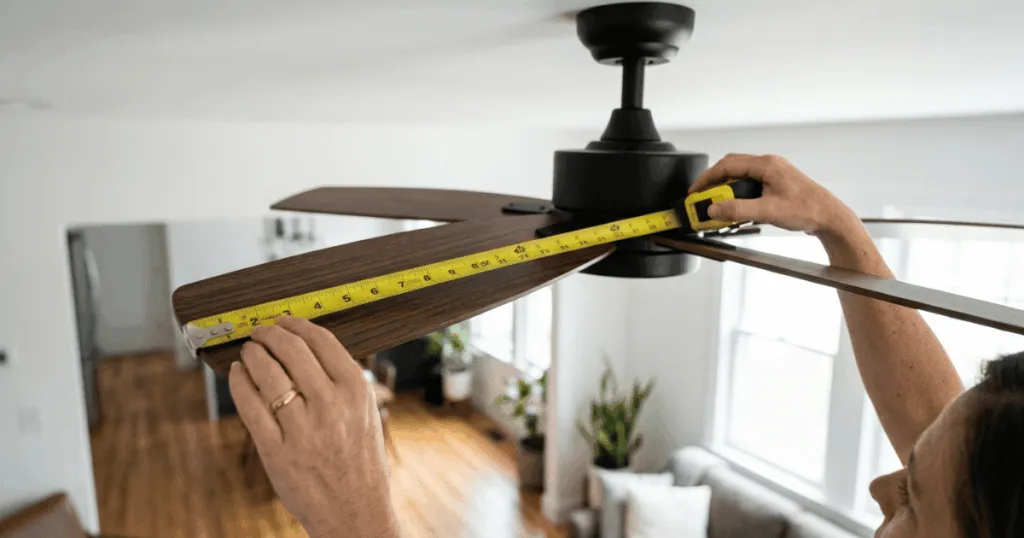
If you are measuring an existing fan to replace it, you will need to measure from the tip of one blade to the tip of the blade directly opposite it. If the fan has an odd number of blades, such as three or five, measuring from tip to tip is impossible. In this case, measure from the center of the motor housing to the tip of one blade, then multiply that number by two. This simple calculation provides the accurate diameter of the fan’s sweep.
Keep a notepad and pencil handy to record your measurements immediately. It is easy to confuse numbers when you are up on a ladder, so write down the ceiling height, the distance from the ceiling to the floor, and the intended blade span. Having these figures written down allows you to cross-reference them against manufacturer specifications later, ensuring you do not rely on memory alone when shopping for a replacement.
Step-by-Step : How to Measure a Ceiling Fan?
Follow these steps to ensure you have the correct data for your ceiling fan installation.
- Measure the Room Dimensions: Calculate the total square footage of the room. For a standard rectangular room, multiply the length by the width. For irregular rooms, break the space into smaller rectangles, calculate the area of each, and add them together. This total determines the recommended blade span.
- Measure the Ceiling Height: Use your tape measure to find the distance from the floor to the ceiling. If the ceiling is sloped, measure at the highest point where the fan will be installed.
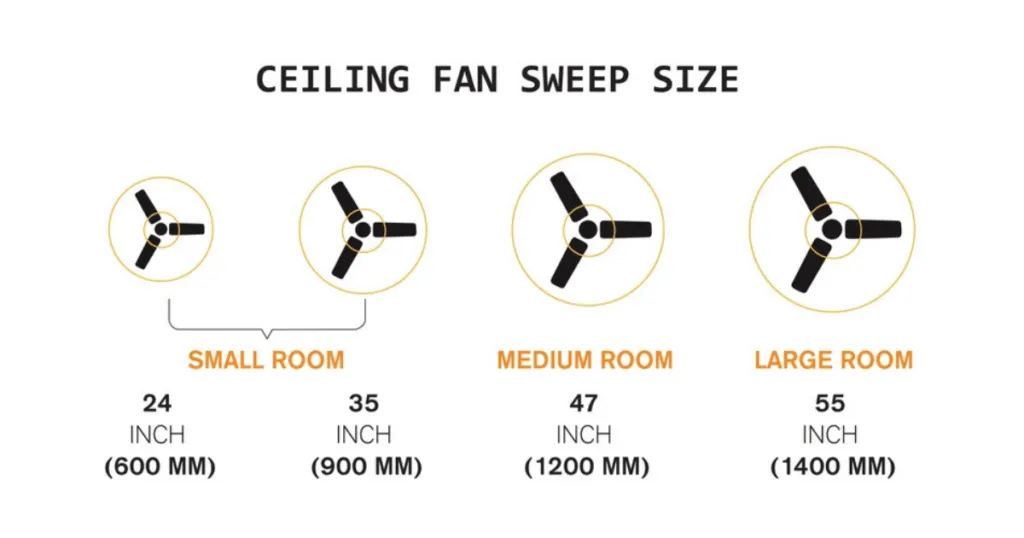
- Determine the Blade Span: If you are measuring an existing unit, measure from the center of the motor housing to the tip of a blade. Multiply this by two to get the total diameter. If you are planning for a new fan, use your room square footage to select a span: 36-44 inches for rooms up to 100 square feet, 44-50 inches for rooms up to 200 square feet, and 52 inches or larger for rooms over 200 square feet.
- Calculate Vertical Clearance: Ensure there is at least 7 feet of space between the floor and the bottom of the fan blades. If your ceiling is 8 feet high, you need a flush mount. If it is 9 feet or higher, you can use a downrod to bring the fan closer to the living area.
- Check Horizontal Clearance: Measure the distance from the center of the mounting point to the nearest wall or tall cabinet. The blade tip should be at least 18 to 24 inches away from any wall to prevent airflow obstruction and potential safety hazards.
Deep Dive: Understanding Blade Sweep and Airflow Efficiency
The term “blade sweep” refers to the total diameter of the circle created by the rotating blades. Understanding this is critical for airflow efficiency. A fan that is too small for a room will require higher motor speeds to move air, which often results in increased noise and mechanical wear. Conversely, a fan that is too large can create excessive air movement, which might feel drafty or uncomfortable in smaller rooms. When measuring for blade sweep, always account for the total diameter, as this is the standard metric used by manufacturers to categorize their products.
When you measure the room, consider the placement of furniture. If you have tall bookshelves or cabinets, these act as horizontal obstructions. Even if the fan is technically 24 inches from the wall, if a tall cabinet sits within that radius, the air will hit the cabinet and create turbulence rather than a smooth breeze. Always measure from the center of the fan to the nearest vertical surface, not just the wall itself.
The Importance of Mounting Types and Ceiling Height Requirements
Ceiling height requirements are non-negotiable for safety. A flush mount fan, often called a hugger fan, is designed for low ceilings where every inch of vertical clearance counts. However, because these fans sit very close to the ceiling, they may have slightly reduced airflow compared to downrod-mounted fans. The downrod acts as a spacer, pulling the fan away from the ceiling to allow air to circulate more freely around the motor housing. If you have a ceiling height of 10 feet or more, a longer downrod is essential to ensure the air reaches the living level. Without it, the fan will simply circulate the air trapped near the ceiling, leaving the room feeling stagnant.
Common Mistakes to Avoid
One frequent error is ignoring the “tip-to-wall” distance. Many people assume that as long as the fan fits in the middle of the room, it is fine. However, if the blades are too close to a wall, the fan will create a vacuum effect, leading to inefficient airflow and potential noise issues. Always maintain at least 18 inches of clearance between the blade tip and any wall or vertical obstruction.
Another mistake is failing to account for light fixtures or other ceiling-mounted items. If you have recessed lighting or a smoke detector near the installation point, ensure the fan blades will not pass directly under them. This is not just about aesthetics; it prevents the “strobe effect” that occurs when a fan blade repeatedly passes between a light source and your eyes, which can be disorienting and uncomfortable.
Finally, do not underestimate the importance of the downrod length. Many homeowners buy a standard fan and realize after installation that it is too high to provide a breeze or too low to be safe. If you have high ceilings, you must purchase an additional downrod. Do not attempt to modify or extend a standard downrod with makeshift hardware, as this compromises the structural integrity of the fan and creates a significant safety risk.
Troubleshooting Measurement Issues
If you find that your room dimensions fall between standard fan sizes, always opt for the larger size if the room is large, or the smaller size if the room is cramped. A slightly larger fan running at a lower speed is often quieter and more efficient than a smaller fan running at high speed. If you are worried about the fan looking too large, choose a model with a slim profile or a finish that matches the ceiling color to minimize its visual impact.
If you encounter a situation where the ceiling height is too low to meet the 7-foot clearance rule, you must prioritize safety over airflow. Do not install a fan that hangs lower than 7 feet from the floor. In this case, look for “low-profile” or “hugger” fans specifically designed for restricted heights. These models eliminate the downrod entirely, mounting the motor housing directly to the ceiling bracket to maximize the available headroom.
If your measurements indicate that a standard fan will be too close to a wall, consider a smaller blade span or a different mounting location. If the room layout does not allow for a central installation, it is often better to skip the ceiling fan in that specific spot rather than installing it in a location where it cannot perform effectively or safely. When in doubt, consult the manufacturer’s installation manual, which provides specific clearance requirements for their particular models.
Advanced Considerations: Sloped Ceilings and Blade Pitch
When measuring for a sloped or vaulted ceiling, the standard approach needs adjustment. You must ensure the fan is compatible with a sloped ceiling adapter. When measuring the clearance, you must measure from the lowest point of the slope where the blade will pass. If the fan is installed on a steep angle, the blade tips will be at different heights relative to the floor.
Always use the measurement of the blade tip closest to the floor to ensure you maintain that critical 7-foot safety clearance. Additionally, consider the blade pitch—the angle of the blade—which affects how much air the fan moves. While not a measurement you take with a tape, it is a specification you should verify against your room size to ensure the fan’s performance matches your expectations.
FAQ
How do I know if my room is too small for a ceiling fan?
If your room is under 50 square feet, a standard ceiling fan may be impractical. In such small spaces, the blades often cannot maintain the required 18-inch clearance from walls, which restricts airflow and can create safety concerns.
Can I use a longer downrod to make my fan more effective?
Yes, if you have high ceilings, using a longer downrod is the correct way to bring the fan blades into the ‘comfort zone’—typically 8 to 9 feet above the floor. This improves air circulation significantly compared to a fan mounted too high.
Does the number of blades affect the measurement?
The number of blades does not change the measurement process, but it does affect the fan’s balance and aesthetic. Regardless of whether a fan has three, four, or five blades, you always measure the diameter from tip to tip or by doubling the distance from the center to one tip.
What happens if my ceiling fan is too close to the ceiling?
If a fan is mounted too close to the ceiling (less than 10-12 inches), it may not be able to pull enough air from above the blades, leading to reduced airflow performance. Always check the manufacturer’s recommended minimum distance for the specific model.