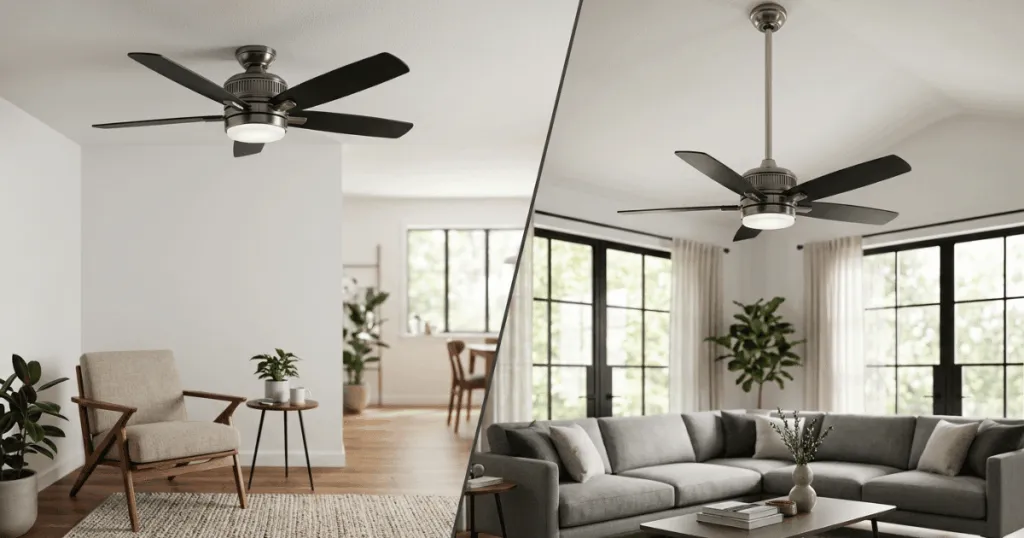
When you encounter a room with a vaulted, cathedral, or sloped ceiling, standard flush-mount fans often fail to provide the necessary clearance or performance. Angled ceiling fans, or more accurately, fans installed with an angled mounting system, are the primary solution for maintaining proper airflow in these architectural spaces. Choosing the right setup ensures that the fan blades remain parallel to the floor, which is essential for effective air circulation and preventing the motor from straining against an uneven load.
Installing a fan on an incline requires more than just picking a model that looks good; it demands an understanding of your ceiling’s specific pitch and the compatibility of the mounting hardware. By addressing these factors early, you avoid common installation pitfalls such as blade-to-ceiling contact or motor wobble, ensuring your comfort remains consistent regardless of the room’s unique geometry.

Understanding the Mechanics of Sloped Ceiling Installations
The core challenge with sloped ceilings is that the mounting point is not horizontal. A standard fan canopy is designed to sit flush against a flat surface, meaning it cannot accommodate an angle without specialized hardware. When you attempt to mount a standard fan on an incline, the canopy will not sit flush, and the downrod will hang at an awkward, non-vertical angle, which ruins the balance of the motor housing.
Most residential ceiling fans are designed to be compatible with a sloped ceiling adapter or a specific mounting bracket that allows the downrod to hang vertically, regardless of the ceiling’s pitch. This adapter acts as a pivot point. It allows the downrod to swing into a true vertical position, ensuring the motor housing stays level. Without this, the fan will likely wobble, create excessive noise, and eventually suffer from premature mechanical failure due to the uneven distribution of weight.
Determining Your Ceiling Pitch
Before selecting a fan or an adapter, you must calculate the pitch of your ceiling. Pitch is typically expressed as a ratio, such as 4/12, which means the ceiling rises 4 inches for every 12 inches of horizontal run. Most standard ceiling fan mounting kits are designed to accommodate slopes up to 20 or 30 degrees. If your ceiling is steeper than this, you will specifically need a high-slope adapter.
To measure this, you can use a simple digital angle finder or a protractor against a level board held against the ceiling. Knowing this number is vital because it dictates the length of the downrod you will need. A steeper slope requires a longer downrod to ensure that the fan blades have enough clearance from the ceiling surface to rotate freely without striking the drywall.
Key Factors for Successful Airflow and Clearance
The primary goal of any ceiling fan is to move air efficiently. In rooms with vaulted ceilings, this is complicated by the fact that heat rises and collects at the peak of the room. An angled ceiling fan setup must be positioned carefully to push that trapped air back down into the living space during the winter or create a consistent breeze during the summer.
Blade clearance is the most critical safety and performance factor. The National Electrical Code and most manufacturer guidelines suggest that fan blades should be at least 7 feet above the floor for safety. However, on a sloped ceiling, you must also ensure the blades are at least 12 to 18 inches away from the ceiling surface itself. If the blades are too close to the ceiling, the fan will experience air cavitation, where the blades struggle to grab air, leading to poor performance and a loud, chopping sound.
The Role of Downrod Length
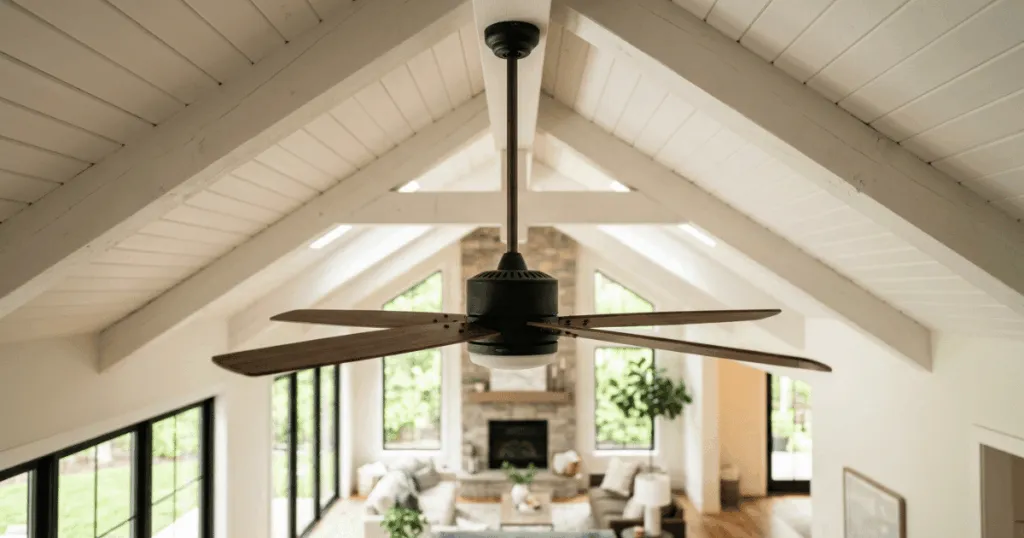
The downrod is the bridge between your ceiling and your comfort. On a flat ceiling, a short downrod is often aesthetic, but on a sloped ceiling, it is a functional necessity. A longer downrod moves the fan assembly away from the angled surface, providing the clearance needed for the blades to operate in open air. If you choose a downrod that is too short, you risk the blades hitting the ceiling at the highest point of the slope.
In practice, homeowners often underestimate the length of the downrod required for high-vaulted ceilings. If your ceiling peak is 15 feet high, you may need a 36-inch or even a 48-inch downrod to bring the fan down to a functional height. Always prioritize the manufacturer’s recommended clearance distances over the visual preference for a shorter rod. A fan that is mounted too high on a vaulted ceiling will simply circulate hot air at the top of the room without providing any benefit to the people below.
Real-World Context: Managing Vaulted Spaces
Consider a living room with a 12-foot vaulted ceiling. This space creates a large volume of air that can feel stagnant in the summer and chilly in the winter. Installing a fan here requires a long downrod to reach the “living zone.” When the fan is placed correctly, it can effectively destratify the air, pulling warm air down from the peak during the winter months when the fan is set to reverse mode.
Another common scenario involves loft spaces or attic bedrooms where the ceiling follows the roofline. These rooms often have very tight clearances. In these instances, you might be tempted to use a flush-mount fan, but these are almost never compatible with slopes. Instead, look for “hugger” style fans that specifically state they are slope-adaptable, or use a short downrod with a pivot-mount canopy. The key is ensuring the motor housing remains level; if it tilts, the internal bearings will wear out unevenly, leading to a loud, clicking fan within a few years.
Why Proper Installation Matters for Longevity
The investment in an angled ceiling fan setup is an investment in the longevity of the appliance. A fan that is installed on an angle without the proper hardware is under constant mechanical stress. The motor is fighting gravity to keep the blades spinning in a flat plane, even though the mounting point is tilted. This leads to increased friction, heat buildup in the motor, and eventually, a burnt-out capacitor or motor failure.
Furthermore, an improperly installed fan creates a safety hazard. If a fan is not balanced or is mounted on an angle that exceeds the hardware’s rating, it can vibrate loose over time. This vibration is not just annoying; it can cause the screws in the mounting bracket to back out. By using the correct slope adapter and ensuring the downrod is plumb, you ensure the fan remains a stable, quiet, and reliable source of comfort for years to come.
Common Misconceptions About Sloped Installations
A frequent mistake is assuming that all ceiling fans can be mounted on a slope. Many entry-level fans are designed strictly for flat ceilings and lack the pivot mechanism in the canopy to handle any degree of incline. Attempting to force these onto a slope by modifying the bracket is dangerous and voids the warranty. Always check the specifications for “sloped ceiling compatibility” before purchasing.
Another misconception is that the fan must be mounted at the very peak of the ceiling. While this is often the most visually symmetrical choice, it is not always the best for airflow. Sometimes, mounting the fan slightly off-center or on a flatter section of the ceiling, if available, can provide better air distribution. Additionally, some people believe that a longer downrod will cause more wobble. In reality, a properly installed, plumb downrod is more stable than a short, improperly angled one. Stability comes from the quality of the mounting bracket and the precision of the installation, not the length of the rod.
Advanced Considerations for High-Vaulted Architecture
When dealing with extreme architectural geometry, such as A-frame homes or custom cathedral ceilings, standard solutions may reach their limits. In these environments, the structural integrity of the mounting box becomes paramount. A standard plastic junction box is rarely sufficient for a heavy fan on a long downrod. You must ensure that the electrical box is rated for fan support and is securely anchored to a structural beam or a heavy-duty fan brace. The leverage exerted by a 48-inch or 60-inch downrod during operation can multiply the force on the mounting point, making a secure, code-compliant connection non-negotiable.
Furthermore, consider the electrical wiring. When using long downrods, you may find that the factory-provided lead wires are too short. While you can extend these wires, it is essential to use the correct gauge of wire and proper, secure connections that are housed within the downrod assembly. Never leave wire nuts or electrical tape exposed outside of the housing or the downrod. If you are uncomfortable with electrical modifications, consult a professional electrician who understands the specific requirements of ceiling fan installations in high-ceiling environments.
Evaluating Fan Performance in Large Volumes
Beyond the mechanical installation, the performance of an angled ceiling fan is dictated by the blade span and motor power. In a large vaulted room, a small fan will be ineffective regardless of how well it is mounted. The “living zone” needs to feel the breeze, which means the fan must be sized appropriately for the square footage of the floor space, not just the height of the ceiling. A larger blade span (56 inches or greater) is often necessary to move enough air volume to make a noticeable difference in a high-ceilinged room.
Additionally, consider the motor type. DC motors are increasingly popular for these applications because they are lighter, more energy-efficient, and often offer a wider range of speed settings. This is particularly useful in vaulted rooms where you might want a very low, silent speed for winter destratification and a high-velocity setting for summer cooling. The reduced weight of a DC motor can also put less strain on the mounting bracket and downrod assembly, which is a subtle but important advantage in complex installations.
Final Checklist for Your Installation
Before finalizing your purchase or starting your installation, verify these four points: 1) The degree of your ceiling slope; 2) The maximum slope rating of the fan’s included canopy; 3) The required downrod length to achieve 12-18 inches of blade-to-ceiling clearance; and 4) The structural rating of your ceiling electrical box. By systematically addressing these requirements, you transform a potentially difficult installation into a straightforward project that enhances the comfort and functionality of your home’s most challenging architectural spaces.
FAQ
Can I install a standard ceiling fan on a sloped ceiling?
Most standard ceiling fans cannot be installed on a sloped ceiling without a specialized sloped ceiling adapter. Without this hardware, the fan will not hang level, leading to motor strain, wobbling, and potential safety risks.
How do I know if my ceiling is too steep for a fan?
Most standard fan mounting kits accommodate slopes up to 20 or 30 degrees. If your ceiling pitch is steeper than this, you must check the manufacturer’s documentation for a high-slope adapter or choose a fan specifically engineered for steep-slope installations.
Does the downrod length affect the fan’s performance on a slope?
Yes. A longer downrod is often required on sloped ceilings to ensure the blades have enough clearance from the ceiling surface. If the blades are too close to the ceiling, the fan will experience air cavitation, resulting in poor airflow and increased noise.