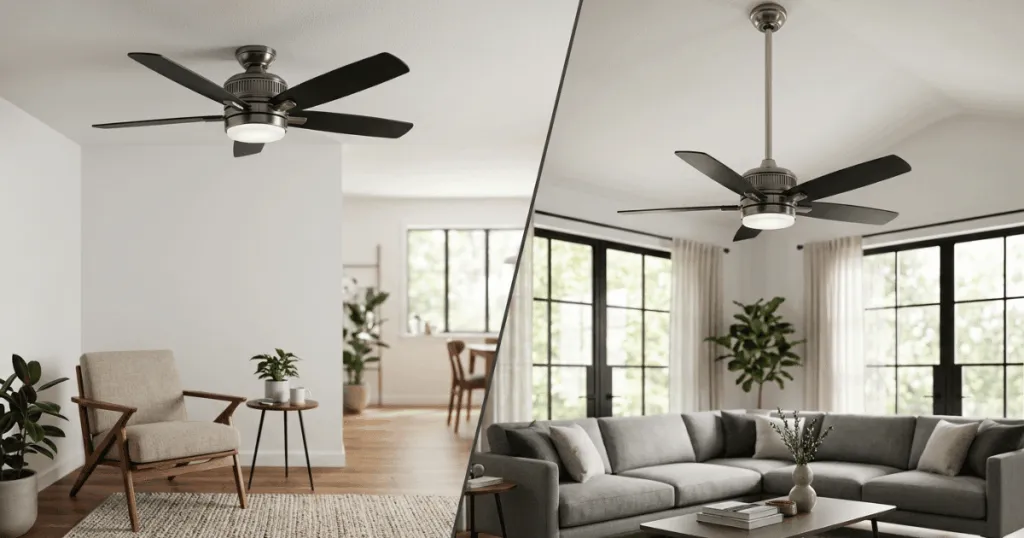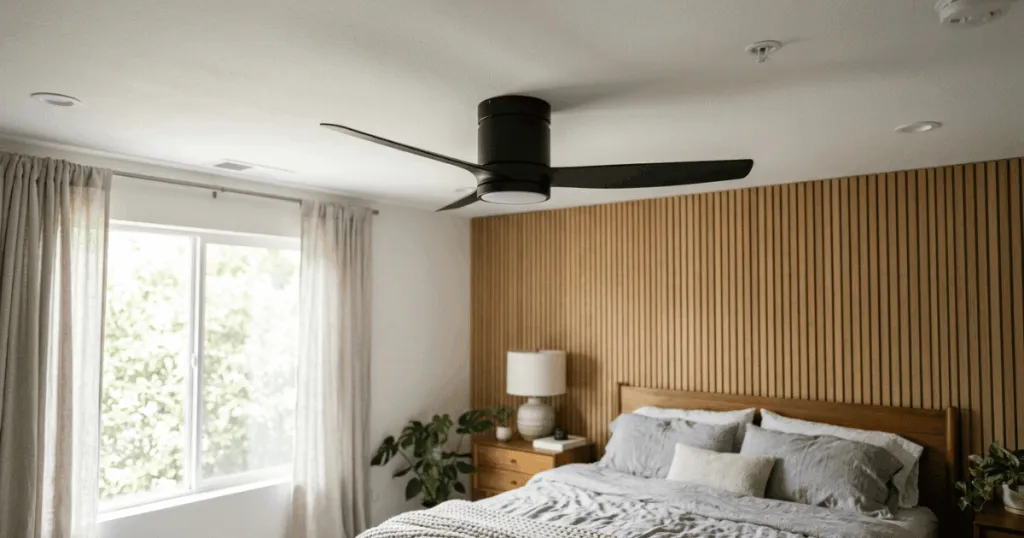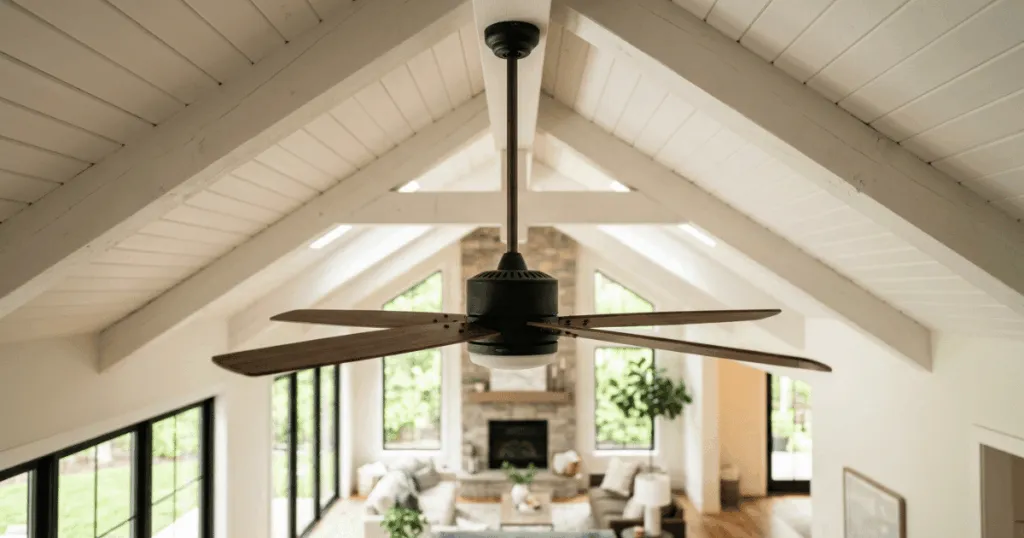
The defining characteristic of Flush Mount Ceiling Fans—often referred to as hugger fans—is their direct attachment to the ceiling canopy without the use of a downrod. While traditional fans rely on a downrod to suspend the motor housing several inches or even feet below the ceiling, these models sit tight against the mounting bracket. This design choice is not merely an aesthetic preference; it is a functional necessity for residential spaces where vertical clearance is limited.
Understanding this distinction is the first step in selecting the right cooling solution for your home. By eliminating the downrod, you gain precious inches of headroom, which is often the difference between a fan being a safety hazard and a functional, comfortable addition to a room. This guide explores the mechanical and practical implications of choosing this style for your living spaces.
When evaluating residential cooling options, the primary differentiator for flush mount units is their ability to integrate seamlessly into the architecture of a room. Unlike standard fans that demand a certain amount of “air space” to hang, flush mounts are engineered to operate within the constraints of standard eight-foot ceilings, which are common in many modern homes and older properties alike. This proximity to the ceiling requires a specific approach to motor housing design and blade geometry, ensuring that the fan remains an effective tool for air circulation despite the lack of a traditional drop.

The Core Benefits and Functional Factors
The primary reason homeowners select Flush Mount Ceiling Fans is the physical limitation of their ceiling height. In rooms with ceilings lower than eight feet, a standard downrod-mounted fan can create a claustrophobic effect and, more importantly, pose a safety risk for taller individuals. By hugging the ceiling, these units maintain the maximum possible clearance, ensuring the blades remain well out of reach while still providing necessary air circulation.
Airflow efficiency is a common point of discussion regarding these models. Because the motor housing sits flush against the ceiling, there is less space for air to be drawn into the top of the fan compared to a downrod model. While modern engineering has mitigated this issue, it remains a factor to consider in larger rooms or areas with high humidity. In practice, this means that for a flush mount fan to perform at its peak, the blades must be designed to compensate for the proximity to the ceiling by maintaining a specific pitch that encourages airflow despite the restricted intake.
Installation complexity is another factor that distinguishes these units from their counterparts. Because the motor housing must be secured directly to the junction box or a specialized mounting bracket, the wiring process can sometimes be tighter than in fans with ample room inside a downrod canopy. You will find that most manufacturers provide specific, low-profile mounting plates designed to handle this close-quarters assembly. Ensuring your electrical box is rated for fan support is critical here, as the weight of the motor is transferred directly to the ceiling structure.
Noise sensitivity is often linked to the mounting style. Since these fans are attached directly to the ceiling, any vibration from the motor is more easily transferred to the drywall or joists. A high-quality flush mount fan includes rubber dampeners or specialized mounting hardware to isolate the motor from the ceiling surface. If you are installing a fan in a bedroom or a quiet home office, prioritizing models with these vibration-dampening features is essential to avoid unwanted humming or rattling sounds.
Real-World Context and Room Application
Consider a standard bedroom with an eight-foot ceiling. Installing a traditional fan with a six-inch downrod might leave the blades at roughly seven feet or less from the floor. For a tall homeowner, this creates an immediate feeling of encroachment. A flush mount model, by contrast, can keep the blades closer to the eight-foot mark, significantly opening up the visual space of the room.
In living rooms or basements where ceiling height might be even lower—perhaps seven and a half feet—the choice becomes even more critical. In these environments, the goal is to provide cooling without creating a visual obstruction. A sleek, low-profile design can disappear into the ceiling, allowing the room to feel larger than it actually is. This is particularly effective in smaller, multi-purpose rooms where you want the utility of a fan without the visual weight of a large, hanging appliance.
Climate also plays a role in your decision. In regions with high summer temperatures, you need a fan that can move a significant volume of air. While flush mount fans are highly effective, they are generally best suited for standard-sized rooms rather than massive open-concept areas. If you have a very large room with a low ceiling, you might find that a single flush mount fan struggles to provide uniform coverage. In such cases, the strategy should shift toward using two smaller, strategically placed flush mount fans to ensure consistent airflow across the entire space.
Maintenance is another practical consideration. Because these fans sit close to the ceiling, they are sometimes slightly more difficult to dust than fans with long downrods. However, the lack of a downrod also means there is one less component to collect dust and cobwebs. A simple long-handled duster is usually sufficient for routine cleaning, making the maintenance trade-off relatively neutral for most homeowners.
Why This Choice Matters for Comfort
The decision to install a flush mount fan is ultimately about balancing the physical requirements of your architecture with the desire for comfort. A ceiling fan is one of the most effective tools for managing indoor climate, as it creates a wind-chill effect that makes a room feel several degrees cooler. By choosing a flush mount model, you ensure that you can utilize this cooling power even in rooms that were previously considered unsuitable for fans due to height constraints.
Beyond the immediate cooling benefit, these fans contribute to the overall energy efficiency of a home. By circulating air, they allow you to rely less on air conditioning during milder weather. This is a practical, low-energy way to maintain comfort. When you select a model that fits your room perfectly, you avoid the common mistake of choosing a fan that feels too large or too low, which can lead to a room feeling cluttered and uncomfortable.
The visual impact of a ceiling fan should not be underestimated. A fan that hangs too low can disrupt the sightlines of a room, making it feel smaller and more fragmented. By opting for a flush mount design, you maintain the architectural integrity of your ceiling. This is especially important in rooms with decorative ceilings or specific lighting layouts where you want the fan to provide utility without dominating the visual landscape of the space.
Engineering and Performance Considerations
When researching low profile ceiling fans, it is helpful to understand the relationship between the motor housing and the blades. Because the motor is tucked tightly against the ceiling, the angle of the blades—known as the blade pitch—becomes a critical performance metric. A steeper blade pitch can move more air, but it also places more strain on the motor. Manufacturers of high-quality flush mount fans balance this by using high-torque motors that can maintain consistent rotation speeds without overheating or excessive noise.
Another technical aspect to consider is the fan mounting bracket. In a flush mount setup, the bracket acts as the sole interface between the ceiling and the fan. Unlike downrod fans, where the ball-and-socket joint allows for some natural movement and self-leveling, a flush mount bracket is rigid. This rigidity is why the structural integrity of your junction box is paramount. If the box is not perfectly level, the fan will likely wobble, which can lead to noise and premature wear. DIY-minded readers should always check that their ceiling box is specifically rated for the weight and torque of a ceiling fan, as standard lighting boxes are rarely sufficient.
Furthermore, the integration of light kits in flush mount designs has evolved significantly. In the past, adding a light kit to a hugger fan often meant adding several inches of bulk, which defeated the purpose of the low-profile design. Today, many manufacturers integrate LED lighting directly into the housing, keeping the profile slim while providing ample illumination. When selecting a model, look for integrated LED options that offer dimming capabilities, as this adds another layer of control to your room’s ambiance.
Common Misconceptions
A frequent misconception is that flush mount fans are inherently less powerful than downrod models. While it is true that they have different airflow dynamics, modern, high-efficiency motors have largely closed this gap. A well-designed flush mount fan can move just as much air as a standard model, provided it is sized correctly for the room’s square footage.
Another common error is assuming that all flush mount fans are the same. In reality, there is a wide range of blade pitches, motor types, and aesthetic styles available. Some are designed specifically for high-airflow performance, while others prioritize a minimalist, low-profile look. It is important to look beyond the mounting style and evaluate the fan’s CFM (Cubic Feet per Minute) rating, which indicates the actual volume of air the fan can move. Always match the fan’s capacity to the size of your room rather than assuming the mounting style dictates the performance.
Finally, some homeowners worry that these fans are difficult to install or repair. While they do require a specific mounting technique, they are not inherently more complex than other types. Most manufacturers provide clear instructions for the flush-mount bracket system, and as long as you have a secure, fan-rated electrical box, the process is straightforward for anyone comfortable with basic home electrical tasks. If you are ever in doubt about the structural integrity of your ceiling or the wiring, consulting a professional is always the safest course of action.
Strategic Planning for Installation
Before purchasing a flush mount fan, assess the room’s layout. Measure the distance from the ceiling to the floor, but also consider the placement of furniture. If you are installing a fan over a bed or a dining table, ensure that the blade sweep does not interfere with any hanging light fixtures or tall furniture pieces. While flush mounts are designed to save space, the diameter of the fan blades still matters. A fan that is too large for a small room can create a “choppy” airflow sensation, while one that is too small will fail to provide the necessary cooling coverage.
Consider the control mechanism as well. Many modern flush mount fans come with remote controls or wall-mounted switches. Because these fans are often installed in rooms with lower ceilings, wall controls are frequently preferred as they eliminate the need to reach up to pull chains, which can be awkward in confined spaces. If you are opting for a smart-home-enabled fan, ensure that the receiver unit fits within the compact housing of the flush mount canopy, as space is at a premium.
Ultimately, the goal is to achieve a balanced room environment. By selecting a fan that complements the room’s scale and provides the necessary airflow, you can transform a low-ceiling space from a cramped area into a comfortable, functional living environment. The key is to prioritize quality components, such as balanced blades and quiet motors, which will ensure that your investment provides long-term comfort and reliability.
FAQ
Are Flush Mount Ceiling Fans suitable for rooms with 8-foot ceilings?
Yes, they are the ideal choice for 8-foot ceilings. They provide the necessary clearance to ensure safety and prevent the room from feeling cramped while still offering effective air circulation.
Can I install a flush mount fan on a sloped ceiling?
Most standard flush mount fans are designed for flat ceilings. If you have a sloped ceiling, you will likely need a fan specifically rated for sloped-ceiling installation, which often requires a specialized mounting kit or a downrod-compatible fan that can accommodate the angle.
Do flush mount fans move less air than downrod models?
While the proximity to the ceiling can restrict air intake, modern flush mount fans are engineered to compensate for this. When sized correctly for the room, they provide comparable airflow to downrod models.
What should I look for in a high-quality flush mount fan?
Look for features like vibration-dampening hardware to ensure quiet operation, a high CFM rating for effective cooling, and a motor type that suits your usage patterns, such as a DC motor for energy efficiency.