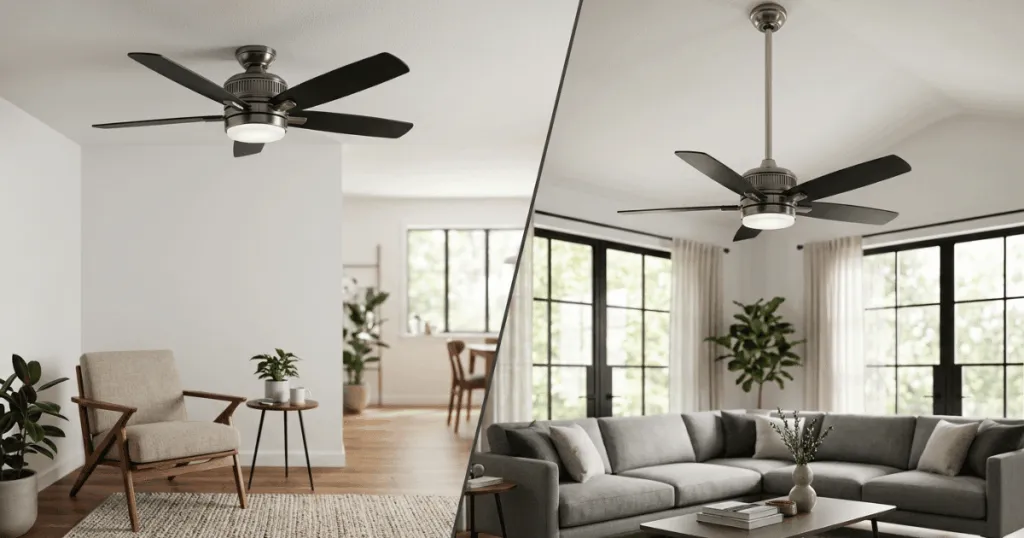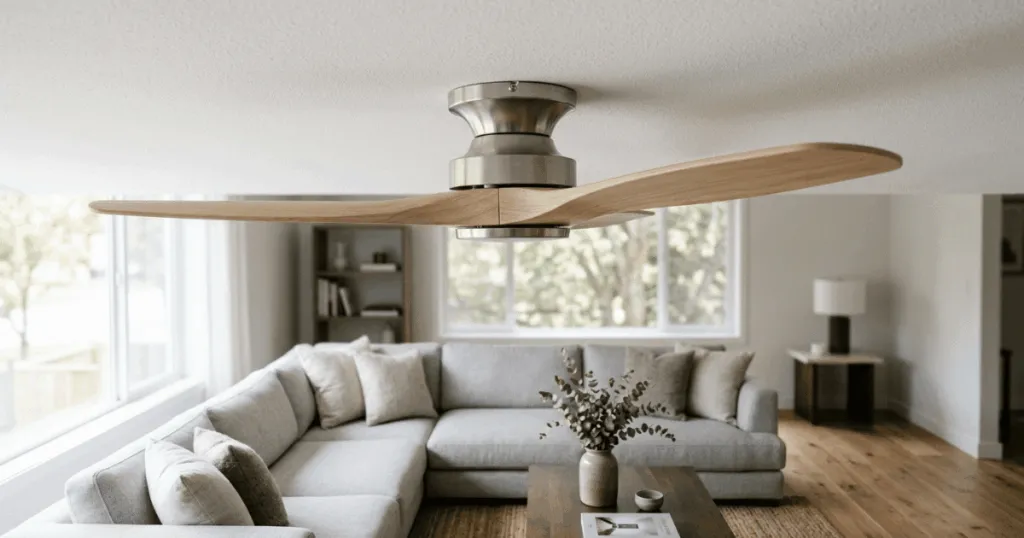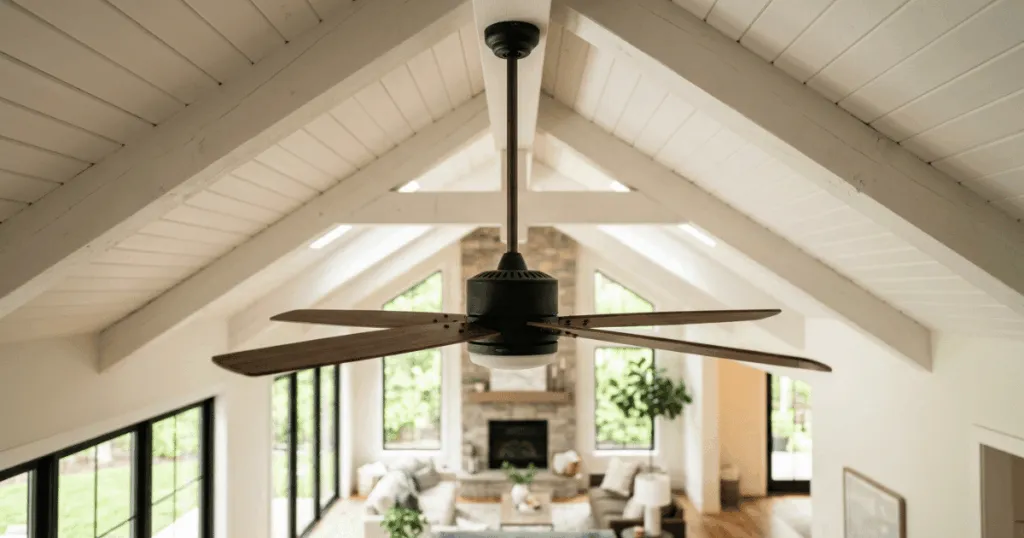
When you have a room with a standard eight-foot ceiling, finding the right air circulation solution often feels like a compromise between safety and performance. Low-profile ceiling fans, frequently referred to as hugger fans, are designed specifically to address this spatial constraint. By eliminating the downrod, these fixtures mount directly to the ceiling canopy, providing the necessary clearance to meet safety codes while still delivering effective airflow.
Choosing the right fan for a lower ceiling is not just about aesthetics; it is a fundamental requirement for maintaining a safe and comfortable living environment. If you install a standard-mount fan in a room with a ceiling height under nine feet, you risk violating safety regulations and creating a hazardous environment for anyone walking beneath the blades. Understanding how these specialized fans function helps you make an informed decision that prioritizes both room utility and long-term comfort.
The Mechanics of Low-Profile Design
The primary defining characteristic of low-profile ceiling fans is the absence of a downrod. In a standard fan configuration, a metal pipe connects the motor housing to the ceiling bracket, allowing the blades to hang several inches or even feet below the ceiling. A hugger fan removes this component entirely, attaching the motor housing directly to the mounting bracket. This design choice shifts the entire assembly upward, typically gaining three to six inches of vertical clearance compared to a standard downrod installation.
From a technical standpoint, this design requires a different internal motor configuration. Because the motor is recessed closer to the ceiling, manufacturers often use specialized, flatter motors to maintain torque and airflow efficiency. While older, budget-oriented models sometimes struggled with airflow due to these constraints, modern engineering has largely closed the gap. Today, you can find high-efficiency DC motors that fit within a slim profile without sacrificing the cubic feet per minute (CFM) output required to move air effectively in bedrooms or smaller living areas.
Balancing Airflow and Proximity
A common concern is whether mounting a fan closer to the ceiling restricts its ability to pull air. It is true that the proximity of the blades to the ceiling surface can create a slight air-starvation effect if the design is poor. However, manufacturers account for this by utilizing specific blade pitches and motor speeds that compensate for the reduced intake space. When selecting a unit, look for models that explicitly state their CFM rating, as this provides a concrete measurement of performance regardless of the mounting style.
In practice, the difference in air movement between a hugger fan and a downrod fan in an eight-foot room is negligible for most homeowners. The real performance drop-off occurs only if the blades are positioned too close to the ceiling, which is why reputable manufacturers design their mounting brackets to maintain a precise, optimal distance. This distance ensures that air is drawn across the blades efficiently rather than being trapped in a dead zone between the motor and the ceiling surface.
Real-World Application in Standard Rooms
In most residential settings, the primary driver for choosing low-profile ceiling fans is the ceiling height. Building codes and industry standards generally recommend that fan blades be at least seven feet above the floor. In a room with an eight-foot ceiling, a standard fan with a six-inch downrod often leaves the blades dangling at roughly seven feet, which is right on the edge of the safety threshold. If you have tall family members or a ceiling that is even slightly lower than eight feet, a standard fan becomes an immediate safety hazard.
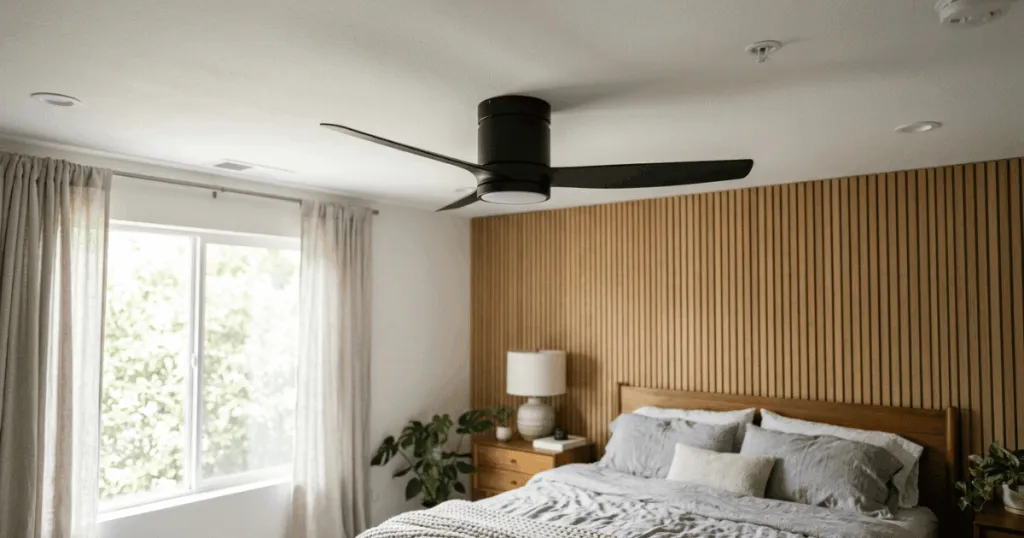
Beyond safety, there is the matter of visual scale. In a room with a low ceiling, a fan that hangs too low can make the space feel cramped and cluttered. By pulling the fan up against the ceiling, you create a more open, airy feeling in the room. This is particularly effective in bedrooms, where you want the air movement but do not want the visual distraction of a rotating fixture hanging directly over your line of sight while lying in bed.
Installation and Structural Considerations
Installing a low-profile fan is often perceived as easier because there is no downrod to balance or secure, but it comes with its own set of requirements. Because the fan sits flush against the ceiling, the ceiling itself must be perfectly level. If your ceiling has a slight slope or is uneven, a hugger fan will highlight these imperfections, whereas a downrod fan can often compensate for a slight tilt. If you are dealing with a vaulted or sloped ceiling, you generally cannot use a true low-profile fan; you must use a downrod-compatible fan with a specialized sloped-ceiling adapter.
Another factor is the electrical box. Because these fans mount flush, the electrical box must be rated for the weight of the fan and properly secured to a ceiling joist. Since there is no downrod to absorb vibration or movement, any instability in the mounting box will be immediately visible as the fan wobbles. Always ensure your junction box is a fan-rated box specifically designed to handle the torque and weight of a ceiling fan, as standard light fixture boxes are not sufficient.
Why This Choice Matters for Comfort
The decision to use low-profile ceiling fans is fundamentally about maximizing the utility of your home’s square footage. Many people avoid installing fans in bedrooms or small home offices because they fear the room will feel smaller or the fan will be too intrusive. By choosing a low-profile model, you remove the physical and visual barriers that make fans feel like an imposition in smaller rooms. This allows you to enjoy the benefits of consistent air circulation—which can help regulate room temperature and reduce reliance on central air conditioning—without sacrificing the aesthetic integrity of your space.
Furthermore, the shift toward DC motor technology in low-profile designs has made these fans quieter and more energy-efficient than their predecessors. In a bedroom setting, where noise sensitivity is high, this is a significant advantage. A modern, well-balanced hugger fan provides a steady, quiet breeze that improves sleep quality during warmer months. When you prioritize the right mount type for your ceiling height, you are not just buying an appliance; you are optimizing the room’s environment for daily comfort.
Common Misconceptions
One of the most persistent myths is that low-profile ceiling fans are inherently less powerful than their downrod counterparts. While this may have been true decades ago, it is no longer the case. Modern engineering has allowed manufacturers to create high-performance motors that function perfectly well in a hugger configuration. If a fan feels underpowered, it is usually due to the blade pitch or motor quality, not the mounting style itself.
Another common mistake is assuming that all hugger fans are universal. In reality, the mounting bracket design varies significantly between brands. You cannot simply swap the motor housing of one fan onto the bracket of another. Always check the manufacturer’s documentation for the specific model to ensure it is compatible with your existing ceiling junction box. Additionally, do not assume that a fan labeled as “low profile” will work on a sloped ceiling; always verify the slope compatibility, as most flush-mount fans are strictly for flat, level surfaces.
Evaluating Performance Metrics for Flush Mounts
When researching potential models, homeowners often get lost in technical jargon. Understanding how to interpret performance metrics is crucial for ensuring the fan you choose actually cools the space. The most important metric is the CFM rating, which stands for cubic feet per minute. This number indicates the volume of air the fan moves at its highest speed setting. For a standard bedroom, you generally want a fan that can move at least 3,000 to 4,000 CFM. Because low-profile fans are often used in smaller rooms, they are frequently optimized for these specific air volume requirements.
Energy efficiency is another metric that deserves attention. Look for the energy star certification, which indicates that the fan meets specific efficiency standards. DC motor ceiling fans are particularly noteworthy here, as they consume significantly less electricity than traditional AC motors. This is not just about reducing utility costs; it is about the longevity of the motor. DC motors run cooler, which is a significant benefit when the motor housing is flush against the ceiling and has less airflow around the exterior of the unit.
Maintenance and Long-Term Reliability
Because low-profile ceiling fans are mounted directly to the ceiling, they can sometimes collect dust more quickly than downrod fans. This is due to the proximity to the ceiling surface, which can create a small vortex that pulls dust from the ceiling into the blades. Regular cleaning is essential to maintain balance and prevent the fan from wobbling over time. A simple wipe-down of the blades every few months with a damp cloth is usually sufficient to prevent buildup.
Regarding structural integrity, the lack of a downrod means that the mounting bracket is the sole point of failure for vibration. If you notice a slight wobble, it is rarely the motor itself; it is almost always an issue with the mounting bracket or the balance of the blades. Most modern fans come with balancing kits, which include small weights that can be clipped to the blades to correct any unevenness. If you have installed the fan correctly on a fan-rated junction box, these minor adjustments are usually all that is required to keep the unit running smoothly for years.
Integration with Smart Home Features
Modern low-profile ceiling fans are increasingly integrating smart technology, which is a major convenience for homeowners. Many models now come with built-in Wi-Fi connectivity, allowing you to control the fan speed, light intensity, and even scheduling through a smartphone app or voice assistant. This is particularly useful in a bedroom setting, where you might want to set the fan to turn off automatically after you fall asleep or adjust the speed without getting out of bed.
When selecting a smart low-profile fan, consider the compatibility with your existing home ecosystem. Some fans use proprietary apps, while others integrate seamlessly with broader platforms. Regardless of the smart features, the core mechanical requirements—proper mounting, sufficient CFM, and a fan-rated box—remain the same. Always prioritize the mechanical quality of the fan first, as the smart features are secondary to the primary function of moving air effectively.
FAQ
Can I install a low-profile ceiling fan on a sloped ceiling?
Most low-profile ceiling fans are designed specifically for flat, level ceilings. Because they mount flush to the surface, they cannot compensate for an angle. If you have a sloped ceiling, you will likely need a fan that supports a downrod with an appropriate sloped-ceiling adapter.
Do low-profile ceiling fans provide less airflow than standard fans?
Not necessarily. While they sit closer to the ceiling, modern low-profile ceiling fans are engineered with specific blade pitches and motor types to maintain effective air circulation. Check the CFM rating of the model to ensure it meets your airflow needs.
What is the minimum ceiling height for a standard ceiling fan?
For safety and effective airflow, it is generally recommended that the blades of a ceiling fan be at least seven feet above the floor. In rooms with eight-foot ceilings, low-profile ceiling fans are the safest and most practical choice to maintain this clearance.