The Short Answer: Choose residential fans for living spaces where quiet operation and aesthetics are key. Select commercial fans for large, high-traffic, or semi-outdoor areas requiring durability. Reserve industrial fans exclusively for utility spaces like workshops or garages where raw airflow volume is the priority over noise control.
When selecting a ceiling fan, the distinction between Residential vs Commercial vs Industrial Fans is not just about aesthetics; it is about matching the engineering of the motor and blade design to the specific airflow requirements of your space. A residential fan is designed for comfort and quiet operation in living areas, while commercial and industrial units prioritize durability and air displacement in larger, more demanding environments. Choosing the wrong category often leads to either inadequate air movement or excessive noise and energy consumption.
For most homeowners, a residential fan is the correct choice for bedrooms, kitchens, and living rooms. However, if you are outfitting a large workshop, a high-ceilinged barn, or a covered patio with specific climate control needs, you may need to look at commercial or industrial specifications. Understanding these categories ensures that you invest in a fan that performs reliably without overwhelming your space with unnecessary power or industrial-grade noise.
Homeowners should approach this decision by first assessing the primary function of the room. If the space is intended for relaxation, sleep, or social interaction, residential units are engineered to maintain a low noise floor. Conversely, if the space is a utility zone, such as a garage or a large-scale hobby workshop, the focus shifts to air movement efficiency and motor longevity under heavy duty cycles. Commercial fans serve as a bridge, offering a robust middle ground for spaces that require more power than a standard bedroom fan can provide but still demand a level of aesthetic refinement that industrial units lack.
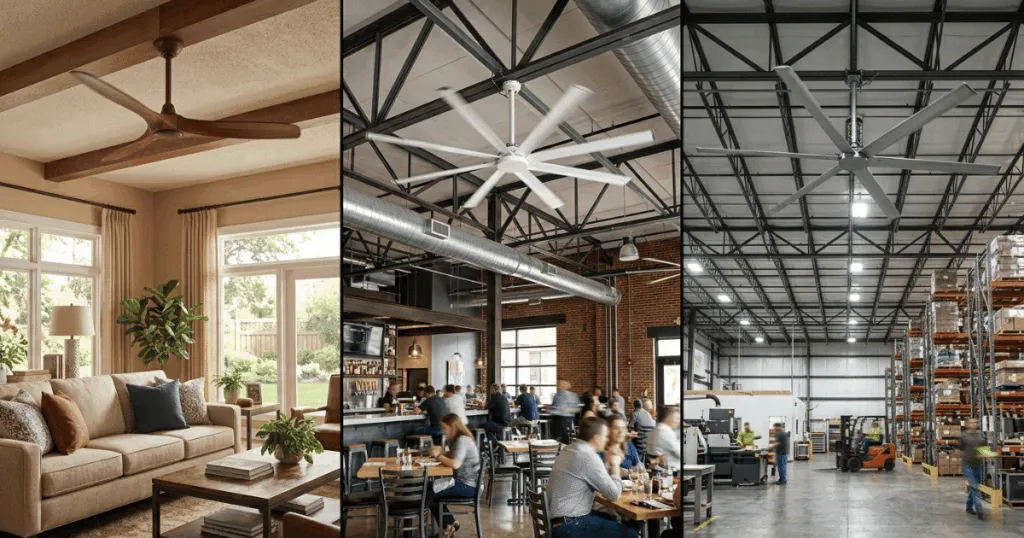
At-a-Glance Comparison of Fan Categories
The primary differences between these fan types center on motor longevity, blade pitch, and control systems. Residential fans are built for aesthetics and moderate duty cycles, focusing on features like integrated lighting and remote control convenience. Commercial fans bridge the gap, offering more robust motors capable of running for longer periods, often in semi-outdoor or high-traffic settings. Industrial fans are purely functional, engineered for maximum air movement in massive volumes, often sacrificing quiet operation for raw performance.
When evaluating these options, consider the environment. A residential fan might struggle in a dusty, high-heat workshop, while an industrial fan would be far too loud and visually intrusive for a bedroom. The following table outlines the fundamental trade-offs you will encounter when comparing these three distinct categories.
| Feature | Residential | Commercial | Industrial |
|---|---|---|---|
| Primary Goal | Comfort & Aesthetics | Reliability & Utility | Airflow Volume |
| Motor Type | Standard AC/DC | Heavy-duty AC/DC | High-Torque/High-Efficiency |
| Noise Level | Very Low | Moderate | High |
| Typical Use | Home Living Areas | Offices, Retail, Patios | Warehouses, Workshops |
| Control | Remote/Wall/Smart | Wall/Integrated | Hardwired/Variable Speed |
Residential Ceiling Fans: Comfort and Aesthetics
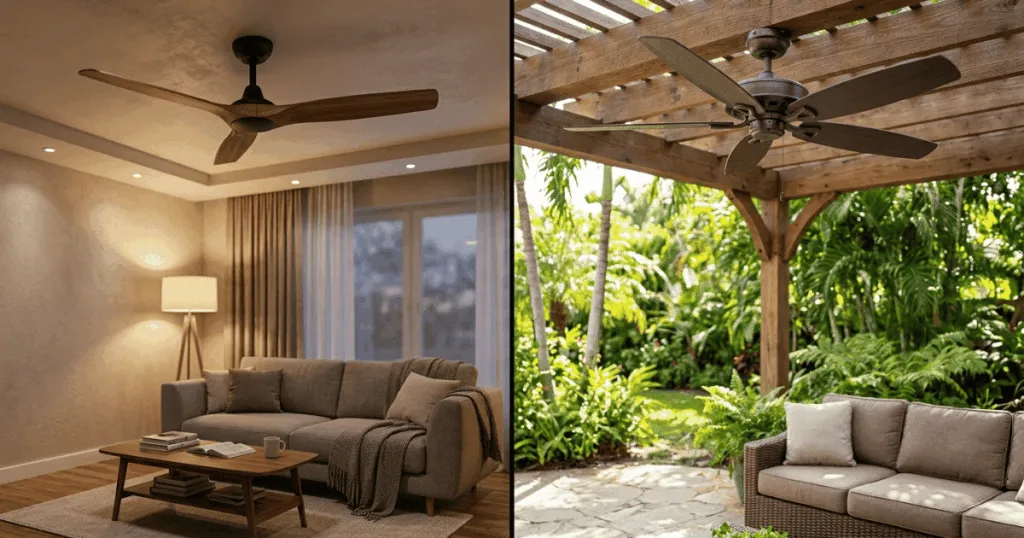
Residential fans are the standard for home environments, where the priority is balancing air circulation with noise control and interior design. These fans are typically engineered for rooms ranging from 100 to 400 square feet. Manufacturers focus on balanced blade sets and whisper-quiet motors that won’t disrupt sleep or conversation. Because they are intended for indoor use, many residential models include light kits and decorative housing finishes that complement home decor.
One of the most important aspects of residential fan selection is the mount type. Whether you need a hugger fan for low ceilings or a downrod mount for vaulted ceilings, residential options offer the most flexibility. These fans are also the most likely to include smart home integration, allowing you to control speed and lighting through mobile apps or voice assistants. If your goal is to cool a bedroom or living area, a residential fan is almost always the best fit.
Beyond the basics, residential fans utilize specific blade pitch angles—usually between 12 and 15 degrees—to optimize air movement without creating excessive turbulence. This design choice is critical for indoor climate control, as it allows the fan to move air effectively at lower RPMs, keeping the motor quiet. When shopping for these, look for energy-efficient DC motor technology, which provides a quieter operation and more granular speed control compared to traditional AC motors.
Commercial Ceiling Fans: Durability for High-Traffic Spaces
Commercial fans occupy a middle ground, often found in offices, retail spaces, or large covered outdoor areas. These units are built to withstand longer run times than residential models and often feature more durable finishes that resist moisture or dust accumulation. While they may lack the decorative flair of residential fans, they offer superior reliability in spaces where the fan might run for eight to twelve hours a day.
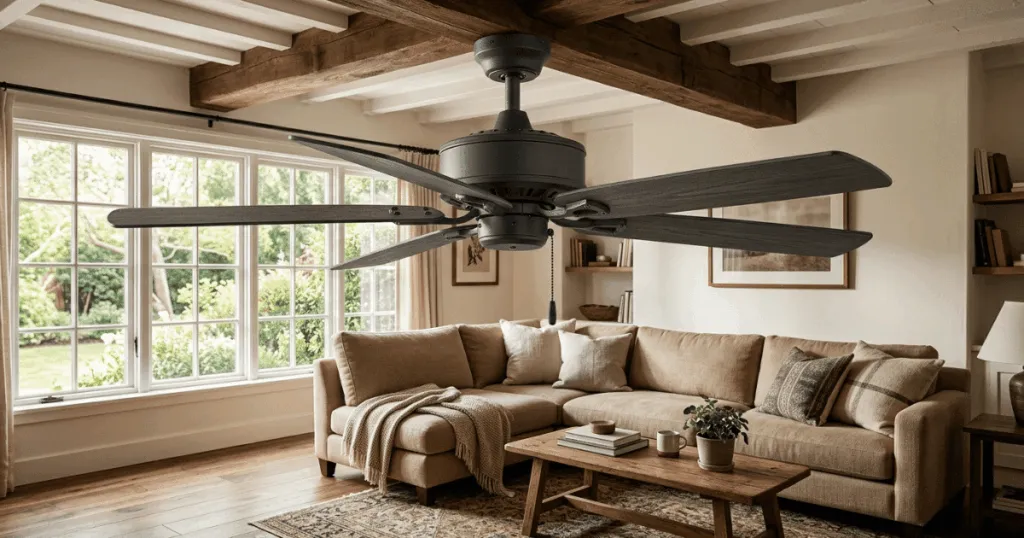
In a home setting, you might consider a commercial-grade fan for a large, high-ceilinged great room or a semi-enclosed patio. These fans often feature larger blade spans and more robust motor housings. They prioritize consistent, reliable airflow over the ultra-quiet operation of a bedroom fan. If you have a space that is larger than standard residential dimensions but you still require a polished appearance, commercial-grade options provide a significant step up in build quality.
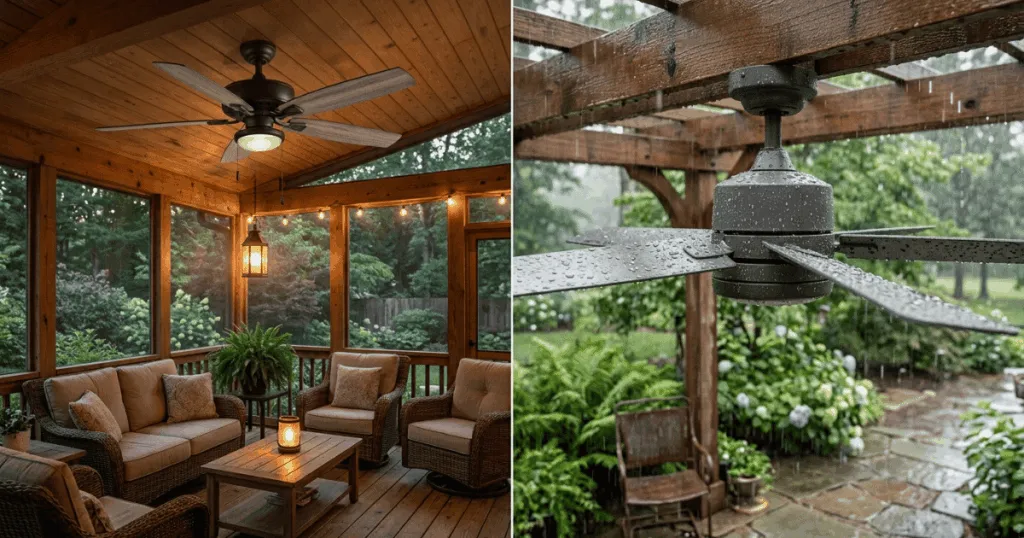
Commercial units are often rated for damp or wet locations, which is a major advantage for homeowners looking to install fans in covered porches or lanais. Unlike residential fans, which may use materials that can corrode or warp in high-humidity environments, commercial-grade fans often utilize stainless steel or powder-coated finishes that resist the elements. This makes them a practical choice for semi-outdoor living spaces where you want the performance of a more durable motor without sacrificing the visual appeal of your home’s exterior.
Industrial Ceiling Fans: Performance and Airflow Volume
Industrial fans are designed for utility, not appearance. These are the workhorses of the fan world, often featuring high-torque motors and heavy-duty metal blades designed to move massive volumes of air. You will typically find these in workshops, garages, or large agricultural buildings. They are not intended for quiet living spaces; the sound of the motor and the air displacement is often significant and would be considered disruptive in a residential bedroom.
The primary advantage of an industrial fan is its ability to circulate air in large, open spaces where residential fans would be completely ineffective. They are built to handle environmental challenges like dust, humidity, and temperature fluctuations that would quickly degrade a residential motor. If you are working in a detached workshop or a large, open-concept barn, an industrial fan provides the airflow necessary to maintain a comfortable working environment, even if it lacks the refined aesthetic of a home-focused model.
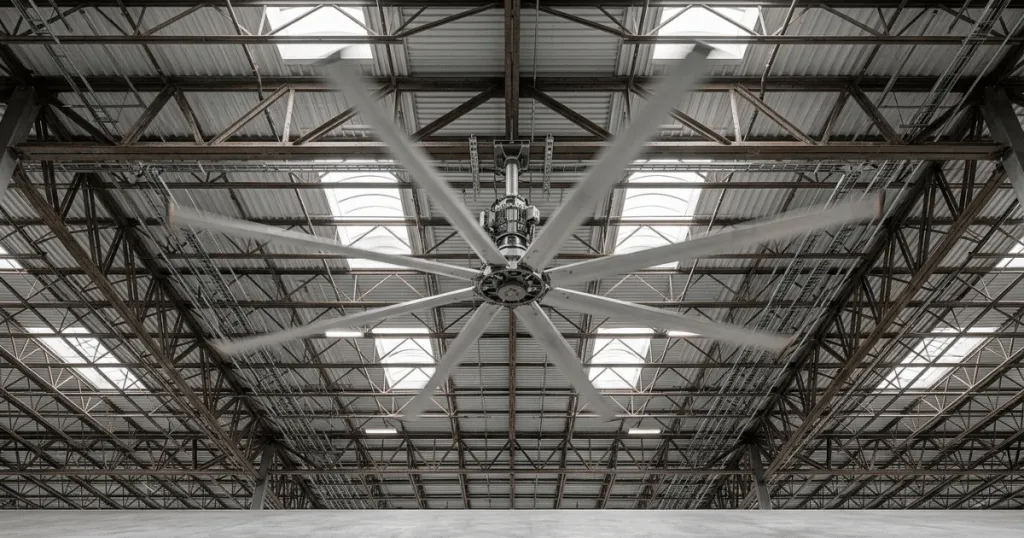
When discussing industrial fans, it is important to understand the concept of destratification. In large, high-ceilinged buildings, warm air naturally rises and gets trapped near the roof, while the floor remains cold. Industrial fans, particularly high-volume, low-speed (HVLS) models, are specifically engineered to push this warm air down, improving HVAC efficiency and reducing heating costs during winter months. While this is a powerful feature for a warehouse, it is rarely necessary in a standard residential room, where ceiling heights are typically 8 to 10 feet.
Feature-by-Feature Comparison
When comparing these fans, the most critical factor is the motor-to-blade ratio. Residential fans utilize motors tuned for efficiency at lower speeds, ensuring a gentle breeze that doesn’t blow papers off a desk. Industrial fans, conversely, use high-torque motors to spin larger, heavier blades at high velocities to push air across vast distances. This makes industrial fans far more effective at destratification, but it also makes them unsuitable for small, confined rooms where the air movement would be overwhelming.
Control systems also vary significantly. Residential fans often rely on wireless remotes or wall-mounted dimmers that are easy to install in existing home wiring. Commercial fans frequently use industrial-grade wall controls or integrated speed controllers that are more durable but less convenient for casual use. Industrial fans often require hardwired, variable-speed controllers that are designed for longevity rather than user-friendly interfaces. Installing a control system for an industrial fan often requires a higher level of electrical knowledge than a standard residential fan replacement.
Maintenance is another key differentiator. Residential fans are largely “set and forget,” requiring only occasional dusting. Commercial and industrial fans, due to their higher usage rates and often harsher environments, may require periodic cleaning of motor housings or checking of blade fasteners to ensure they remain balanced. In an industrial setting, you might also need to inspect the motor’s cooling vents to ensure they aren’t clogged with debris, a task rarely required for residential ceiling fans.
Best Use Cases for Each Category
Residential fans are best for bedrooms, living rooms, and dining areas where noise sensitivity and aesthetic integration are the top priorities. If you are looking to improve comfort in a standard-sized room within your home, a high-quality residential fan is the only logical choice. These fans are specifically engineered to provide a comfortable “breeze” effect rather than raw air displacement.
Commercial fans are the ideal choice for large, open-concept living spaces, covered patios, or home offices that see heavy daily use. If you have a “great room” with 12-foot ceilings, a standard residential fan might look undersized and fail to move enough air. A commercial-grade fan provides the extra reach and durability needed for these larger volumes without the harsh, utilitarian look of an industrial unit.
Industrial fans should be reserved for non-living spaces. If you have a detached garage, a large workshop, or a hobby space where you are actively working with tools or machinery, an industrial fan is the right tool. They are designed to move air in environments where dust or temperature control is a challenge. Using an industrial fan in a living area is a common mistake that leads to disappointment due to the noise levels and the lack of refined control options.
Navigating Installation Standards and Electrical Requirements
One often overlooked aspect of this comparison is the installation standard. Residential fans are designed for standard junction boxes found in most homes. They are lightweight and easy to mount using standard hardware. Commercial and industrial fans, however, are significantly heavier. Installing an industrial fan often requires a reinforced junction box or a direct structural mount to a ceiling joist to handle the weight and the torque generated by the motor.
Furthermore, electrical wiring for industrial fans may require specific circuit considerations. Because these fans often draw more power and use different control interfaces, you may need to consult with an electrician to ensure your existing wiring can support the load. Residential fans are designed for plug-and-play compatibility with standard home electrical systems, making them the most accessible option for DIY installation.
The Role of Blade Pitch and Airflow Efficiency
Blade pitch is the angle at which the fan blade sits in relation to the floor. Residential fans typically feature a blade pitch between 12 and 15 degrees, which is optimized for moving air gently and quietly. If you increase the pitch, you move more air, but you also increase the strain on the motor and the noise level. Industrial fans often feature steeper pitches to maximize air displacement, which is why they are so effective at moving large volumes of air but are inherently louder.
When selecting your fan, consider the CFM rating (cubic feet per minute). A residential fan might have a CFM rating of 4,000 to 6,000, which is plenty for a bedroom. An industrial fan can easily exceed 20,000 CFM. Choosing an industrial fan for a small room is like using a fire hose to water a houseplant; the power is unnecessary and will likely cause more problems than it solves, such as blowing items off tables or creating an uncomfortable, gusty environment.
Which One Should You Choose?
Deciding between these categories comes down to two factors: the physical size of the room and the intended use of the space. If you are cooling a space where people sleep, relax, or watch television, stick to residential fans. The noise floor of commercial and industrial fans is simply too high for these environments, and the aesthetic design of residential fans is better suited to home interiors.
If you are dealing with a large, high-ceilinged space that serves as a multi-purpose area, look at commercial-grade fans. They offer the best compromise, providing the extra airflow and durability of a heavier-duty motor while maintaining a design that doesn’t look out of place in a home. They are particularly effective for covered outdoor areas where humidity resistance is important.
Reserve industrial fans strictly for utility-focused spaces. If you find yourself needing to move air in a workshop or a large storage area, the raw power of an industrial unit is unmatched. However, do not be tempted by the “power” of an industrial fan for your living room; the trade-off in noise and lack of comfort-focused controls will make the space feel more like a warehouse than a home. When in doubt, prioritize the noise level and the intended atmosphere of the room over the raw CFM rating.
FAQ
Can I install an industrial fan in my living room for better cooling?
It is generally not recommended. Industrial fans are designed for performance over comfort, meaning they are significantly louder and lack the refined speed controls and aesthetics required for a living space.
What is the main difference between residential and commercial fan motors?
Residential motors are optimized for quiet, intermittent use in home environments, while commercial motors are built for higher duty cycles and greater durability in settings like offices or retail spaces.
Are commercial fans suitable for outdoor use?
Many commercial fans are rated for damp or wet locations, making them excellent choices for covered patios, but always check the specific UL rating of the model to ensure it matches your environment.
Do industrial fans help with heating costs?
Yes, through a process called destratification. By running the fan in reverse at a low speed, industrial fans can push warm air trapped at the ceiling down to the floor level, which can improve the efficiency of your heating system in large, high-ceilinged buildings.