When installing a new ceiling fan, the most critical factor for both safety and performance is understanding Ceiling Fan Clearance & Height Requirements. Many homeowners focus primarily on style or motor power, yet if the blades are mounted too low, they pose a physical hazard; if they are mounted too high, the fan loses its ability to circulate air effectively. Achieving the right balance ensures that your fan operates within its design parameters while keeping your living space comfortable and secure.
In practice, the standard industry recommendation is to maintain at least seven feet of clearance between the fan blades and the floor. While this might seem like a simple rule, the geometry of your ceiling—whether it is sloped, vaulted, or standard flat—often complicates the installation process. By aligning your fan choice with your specific room dimensions, you can avoid the common pitfalls that lead to ineffective airflow or, worse, safety concerns.

The Fundamentals of Vertical Clearance
The primary reason for strict height requirements is the physical safety of the room’s occupants. A ceiling fan that hangs too low creates a risk of injury, especially in high-traffic areas or rooms where people frequently raise their arms, such as bedrooms or home offices. The seven-foot rule serves as the baseline for residential safety, ensuring that even taller individuals can move freely without the risk of contact with moving blades.
Beyond safety, vertical clearance dictates how efficiently the fan moves air. If a fan is mounted too close to the ceiling, the blades may struggle to pull enough air into the intake, leading to a phenomenon known as air starvation. This reduces the fan’s ability to create a consistent breeze, forcing the motor to work harder for less output. Conversely, mounting a fan too far down on a very long downrod can create a “dead zone” where the air is pushed around the perimeter of the room rather than directly over the occupants.
Calculating Downrod Lengths
To determine the correct downrod length, you must first measure the distance from the ceiling to the floor. Subtract the seven-foot safety requirement from your total ceiling height to find the maximum allowable length for the fan assembly. For example, in a room with a nine-foot ceiling, you have two feet of available space to accommodate the fan motor and the blades.
It is important to remember that the fan motor housing and the blade pitch also occupy space. If your ceiling height is exactly eight feet, a standard flush-mount or “hugger” fan is often the most practical choice. Attempting to use a downrod in an eight-foot room will almost certainly drop the blades below the recommended safety threshold, creating an uncomfortable and potentially hazardous environment.
Managing Airflow and Blade Proximity
Airflow efficiency is heavily dependent on the distance between the blades and the ceiling. Most manufacturers design their fans to perform best when there is at least 10 to 12 inches of space between the ceiling and the blades. This gap allows the fan to draw air from above and push it downward, creating the wind-chill effect that makes a room feel cooler during warmer months.
When you install a fan too close to the ceiling, the blades are essentially “choked,” as they cannot draw in sufficient air volume. This is why hugger-style fans, while excellent for low-ceiling rooms, are often slightly less efficient than downrod-mounted models. If you have the luxury of higher ceilings, utilizing a downrod to drop the fan into the optimal airflow zone will always yield better results than mounting it flush to the ceiling.
The Role of Blade Pitch
Blade pitch—the angle at which the blade is set—also influences how much clearance you need. A steeper blade pitch moves more air but requires a more powerful motor and can sometimes create more drag. If you are installing a high-performance fan with a steep blade pitch, ensure that the mounting height allows for maximum air intake. If the fan is too close to the ceiling, that steep angle will only serve to increase the air resistance, potentially causing the fan to vibrate or wobble during operation.
Real-World Context: Sloped and Vaulted Ceilings
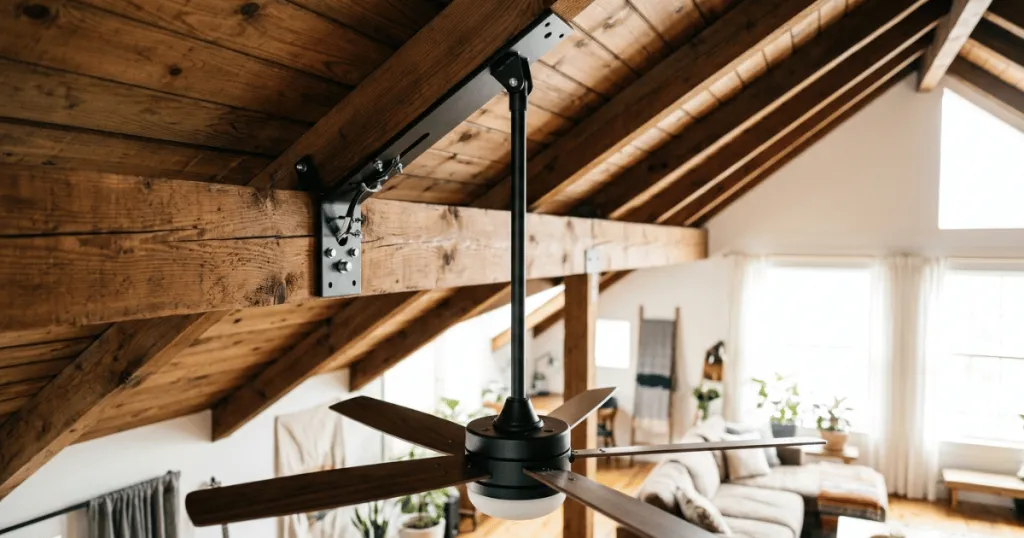
Sloped or vaulted ceilings present a unique challenge for Ceiling Fan Clearance & Height Requirements. In these rooms, the fan must be mounted so that the blades remain level and clear of the sloped surfaces. You will typically need a specialized sloped-ceiling adapter kit to ensure the downrod hangs perfectly vertical, regardless of the ceiling’s pitch.
In a vaulted room, the center of the room is often much higher than the walls. If you mount a fan at the peak, you may need a significantly longer downrod to bring the fan down to a functional height. However, be cautious: if the downrod is too long, the fan may become a focal point that feels disconnected from the rest of the room’s decor. Always prioritize the seven-foot clearance rule at the lowest point of the blade’s rotation to ensure safety.
Obstacle Avoidance
Another practical consideration is the proximity of the fan to other room features, such as lighting fixtures, cabinet doors, or tall furniture. A common mistake is installing a fan that is too large for the room, causing the blade tips to pass too close to wall-mounted cabinets or high-back chairs. Always measure the blade sweep and ensure that there is at least 24 inches of clearance between the tip of the blade and any nearby wall or obstruction to prevent air turbulence and potential damage.
Why Proper Height Matters
Adhering to these height requirements is not just about following a manual; it is about ensuring the longevity of your investment. A fan that is installed correctly will run quieter, consume less energy, and provide a consistent, comfortable breeze. When a fan is mounted improperly, the resulting air turbulence can cause the motor to hum or the blades to wobble, which are common sources of frustration for homeowners.
Furthermore, proper clearance is essential for the safety of children and pets. In homes with bunk beds or lofted sleeping areas, you must be extra vigilant. If a ceiling fan is located anywhere near a raised sleeping surface, the seven-foot rule must be measured from the top of the mattress, not the floor. Ignoring this can lead to serious accidents, making it a non-negotiable aspect of home safety planning.
Common Misconceptions
A frequent error is the belief that “longer is better” when it comes to downrods. Many homeowners assume that dropping a fan lower will always increase airflow, but this is only true up to a point. Once you exceed the optimal distance from the ceiling, you lose the benefit of the air circulation pattern, and the fan may simply stir the air in a localized column rather than moving it throughout the room.
Another misconception is that all fans can be installed on sloped ceilings. This is incorrect; many standard fans are designed for flat surfaces and lack the internal hardware to accommodate an angled mount. Always check the manufacturer’s specifications for the maximum allowable slope angle. If your ceiling exceeds this angle, you must use a compatible adapter to maintain the integrity of the installation and ensure the fan remains balanced over time.
Advanced Installation Considerations for Homeowners
Beyond the basic seven-foot rule, homeowners must consider the interaction between fan placement and room layout. In open-concept living areas, the fan is often the centerpiece of the room. However, if the fan is placed too close to a kitchen island or a dining table, the blades may create an uncomfortable breeze that cools food too quickly or blows napkins and lightweight items off the table. This is why the horizontal clearance—the distance from the blade tip to the nearest wall or tall object—is just as vital as the vertical clearance.
When evaluating your room dimensions, consider the “throw” of the fan. A larger fan with a wider blade sweep moves air across a larger surface area, but it also requires more room to operate safely. If you are working with a smaller room, a smaller fan with a higher RPM (revolutions per minute) might be more effective than a large, slow-moving fan that feels cramped in the space. Always prioritize the manufacturer’s guidance on minimum room size to ensure the fan’s performance matches the intended environment.
Troubleshooting Height-Related Issues
If you find that your fan is performing poorly, the first step is to re-evaluate your installation height. If the fan is too close to the ceiling, you might notice a “chopping” sound or excessive noise. This is often caused by the blades cutting through air that has not yet been properly circulated, creating turbulence. By installing a longer downrod, you can move the blades into a space where they can draw air more freely, which often resolves the noise issue entirely.
Conversely, if you feel that the fan is not providing enough cooling, check if the fan is mounted too low. While it seems counterintuitive, a fan that is too low can create a concentrated, narrow column of air that misses the occupants entirely. In such cases, shortening the downrod can help the fan distribute air more broadly across the room, improving the overall comfort level. Always make small adjustments and test the airflow before finalizing your installation.
The Impact of Ceiling Fan Maintenance on Clearance
Over time, the weight of dust accumulation on the blades can affect the fan’s balance, leading to wobbling. While this is a maintenance issue, it is directly related to clearance because a wobbling fan effectively reduces the safety clearance. If a fan wobbles, the blades are no longer rotating in a perfectly flat plane, which means the lowest point of the blade rotation is constantly changing. This can bring the blades closer to the floor than intended, potentially violating your safety margins. Regular cleaning and balancing are essential to maintain the integrity of your installation and ensure that your clearance requirements remain met throughout the life of the fan.
FAQ
What is the minimum ceiling height for a ceiling fan?
The standard safety recommendation is to maintain at least 7 feet of clearance between the floor and the fan blades. For rooms with 8-foot ceilings, a hugger or flush-mount fan is typically required to meet this safety standard.
How much space should there be between the ceiling and the fan blades?
For optimal airflow, most manufacturers recommend a gap of 10 to 12 inches between the ceiling and the blades. This allows the fan to draw in enough air to circulate effectively throughout the room.
Can I install a ceiling fan on a sloped ceiling?
Yes, but you must use a sloped-ceiling adapter kit to ensure the downrod hangs vertically. Always check the manufacturer’s maximum slope rating before purchasing to ensure the fan is compatible with your ceiling’s pitch.