Key Takeaway: No, ceiling fan downrods are generally not universal across different brands. Proprietary designs for motor yokes, hanging balls, wiring clearance, and pin placements mean you must use manufacturer-approved parts for safe installation.
Are ceiling fan downrods universal? No, ceiling fan downrods are generally not universal across different brands, and attempting to mix parts from different manufacturers can create serious safety hazards. While a downrod is fundamentally just a hollow metal pipe, the precise engineering details at both ends vary significantly from one manufacturer to another. Homeowners often assume any standard threaded pipe or spare rod from an old fixture will fit their new appliance, but this assumption overlooks critical mechanical differences.
Understanding these compatibility limits prevents frustrating installation delays and ensures your ceiling fan operates safely at high speeds without dangerous wobbling or structural failure. We generally recommend sticking strictly to manufacturer-approved replacement parts whenever you need to adjust your hanging height.
Why Downrod Interchangeability Fails Across Different Manufacturers
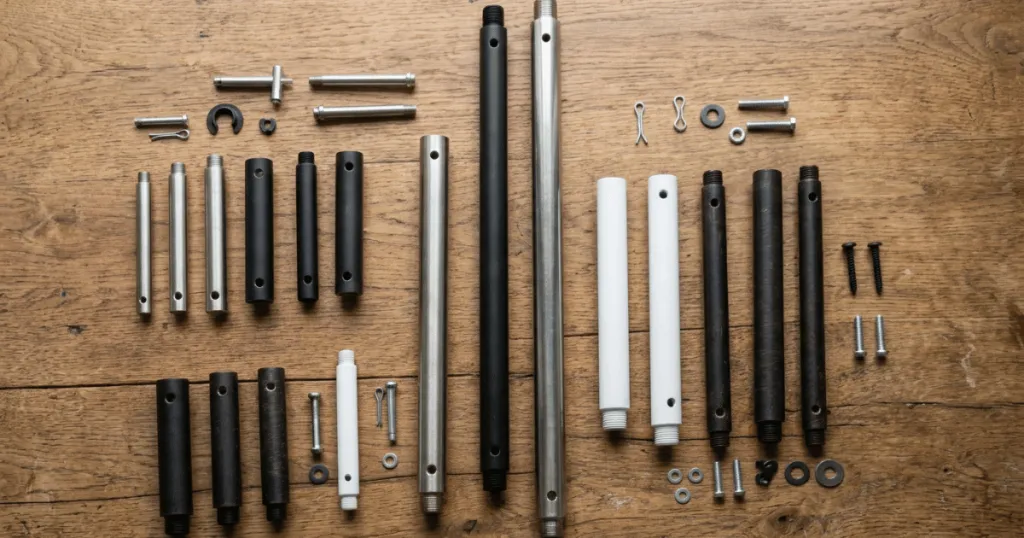
The primary reason downrods lack universal compatibility comes down to proprietary engineering designs at the connection points. Every brand uses unique specifications for securing the metal pipe to the motor housing and the hanging ball assembly. If you try to force a rod from one manufacturer into a fan made by another, you will likely encounter mismatched measurements that prevent proper installation.
Internal wiring clearance also restricts cross-brand usage. Downrods must house thick electrical wires safely without pinching or chafing against sharp metal edges during operation. Different brands route these wires through distinct inner channels, and some incorporate internal grounding terminals or unique plug harnesses that require specific clearance space inside the pipe.
Thread pitch and pin placement represent another major barrier to universal application. The cross-pin holes drilled near the ends of the downrod must align perfectly with the holes in the motor coupling and canopy yoke. Even a fraction of a millimeter variance in hole placement or pin diameter means the safety cotter pin will not slide through, leaving the entire assembly unsecure.
Critical Design Variations That Prevent Universal Use
To understand why you cannot swap these components freely, you need to examine the specific engineering points where downrods attach to the rest of the fixture. Manufacturers design these connection assemblies as closed proprietary systems for structural integrity and liability reasons.
The Motor Coupling and Yoke Interface
The lower end of the downrod inserts into the motor yoke, where a specialized set screw and cross-pin lock it in place. Different brands use varying inner diameters, wall thicknesses, and depth tolerances for this receiving collar. A rod that is slightly too thick will not slide into the yoke, while a rod that is too thin will introduce dangerous lateral play that leads to excessive wobbling.
Hanging Ball Assemblies and Canopy Fit
The upper end of the downrod features a hanging ball that rests inside the mounting bracket attached to your ceiling box. These hanging balls vary widely in outer diameter, curvature, and material composition. A hanging ball that does not seat correctly in the ceiling bracket can slip, rattle, or fail to pivot properly, compromising the dampening effect designed to absorb motor vibrations.
Proprietary Locking Mechanisms and Safety Pins
Most modern ceiling fans rely on a dual-locking system consisting of a set screw and a heavy-duty cross-pin that passes entirely through both the yoke and the downrod. The exact placement and diameter of this pin hole are unique to each brand. Drilling your own holes into a non-matching metal rod weakens its structural integrity and instantly voids the manufacturer warranty.
Real-World Scenarios and Replacement Challenges
Homeowners usually discover downrod compatibility issues during a room renovation or when moving an existing fixture to a space with a different ceiling height. Picture a living room with a vaulted ceiling where the standard four-inch rod included in the box leaves the blades hanging far too high to capture air effectively. You head to the hardware store looking for a longer extension rod.
If you grab a generic metal conduit or a replacement rod made by an unrelated lighting manufacturer, you will likely find that the outer diameter matches roughly, but the threading or pin holes do not align. In practice, forcing an incompatible rod means the set screw cannot bite into the metal properly. Over time, the continuous torque from a spinning motor causes loose set screws to back out completely, creating a severe safety risk.
Another common scenario involves specialized decorative finishes. Oil-rubbed bronze, brushed nickel, and matte black finishes vary drastically in hue and texture across brands. Even if a third-party rod physically slipped into your motor housing, the color mismatch would be immediately noticeable against the rest of the ceiling fan hardware.
Consider another frequent homeowner dilemma involving legacy fans. If you inherit a ceiling fan without an instruction manual or packaging labels, identifying the exact manufacturer becomes a guessing game. Trying to source an extended ceiling fan downrod for an unbranded or discontinued model often results in ordering multiple incorrect parts online. Returning mismatched components delays your room completion, whereas understanding that parts are not universal encourages you to check compatibility guides before purchasing accessories.
Why Downrod Compatibility Matters for Safety and Performance
Ceiling fans generate substantial kinetic energy and continuous rotational torque while spinning at high revolutions per minute. The downrod serves as the sole structural link supporting that heavy motor and blade assembly overhead. Using an engineered component designed specifically for your exact model ensures that the metal gauge, tensile strength, and connection tolerances meet strict safety standards.
A poorly fitted downrod introduces micro-vibrations that amplify over time. These vibrations loosen electrical connections, strain the ceiling electrical box, and produce annoying humming noises. When you maintain a unified system from the same manufacturer, the dampening rubber isolators and locking pins work together as intended to absorb mechanical stress.
From a warranty and liability perspective, mixing non-approved parts is a gamble. Major ceiling fan manufacturers explicitly state in their installation manuals that using third-party downrods voids the product warranty. If a mechanical failure occurs because an unapproved rod snapped under load, you bear the full responsibility for any resulting property damage or personal injury.
Maintaining structural integrity also prevents premature wear on internal bearings. When a fan hangs straight and true, the rotational force is distributed evenly across the motor assembly. A mismatched downrod that introduces even a tiny degree of lean forces the motor bearings to work harder on one side. Over months of daily operation, this uneven friction generates heat, reduces motor efficiency, and eventually leads to permanent motor burnout long before the expected lifespan of the appliance.
Common Misconceptions About Ceiling Fan Hardware
Many DIY enthusiasts assume that because all downrods look like simple metal pipes, they must be interchangeable standardized plumbing items. In reality, ceiling fan manufacturing involves precise engineering tolerances that far exceed standard plumbing or electrical conduit specifications. A standard electrical nipple from the local hardware store lacks the specialized pin channels and heavy wall thickness required for suspended rotational loads.
Another widespread myth is that you can safely modify a slightly mismatched rod by drilling a new pin hole or filing down the edges. Altering the metal compromises its structural integrity, creating a weak point right where the highest mechanical stress occurs. A modified rod can snap suddenly under the centrifugal force of the spinning motor.
People also frequently believe that indoor and outdoor downrods are interchangeable as long as the length is correct. Wet-rated and damp-rated fans often require specific exterior coatings, corrosion-resistant internal treatments, and specialized rubber gaskets at the canopy to prevent moisture ingress. Swapping these parts incorrectly can lead to electrical shorts or premature rust buildup.
Another persistent myth is that any universal ceiling fan downrod replacement kit sold online will work with any brand as long as the diameter matches the outer measurement. In practice, the internal threading patterns, ground wire placement, and upper hanging ball dimensions differ widely. Believing that a universal kit fits all fans frequently results in frustration when the canopy fails to slide up flush against the ceiling because the hanging ball is too bulky or shaped differently than your original hardware.
How to Choose and Install the Right Downrod for Your Fan
When you need to change your hanging height, start by identifying the exact brand and model number of your ceiling fan. Look up the manufacturer catalog for approved accessory downrods designed specifically for your series. This guarantees that the finish, diameter, pin alignment, and wire clearance match your exact fixture.
Measure your ceiling height carefully to calculate the correct downrod length. Industry guidelines recommend keeping the fan blades between eight and nine feet above the finished floor for optimal airflow efficiency in standard rooms. For vaulted or sloped ceilings, ensure you also purchase a compatible angled ceiling adapter if the standard mounting bracket cannot achieve the required tilt.
During installation, inspect every connection point thoroughly before restoring power. Verify that the cross-pin passes completely through the motor yoke and the downrod, secured tightly by the cotter pin or locking clip. Tighten all set screws securely using a hand tool rather than a power drill to avoid stripping the delicate threads inside the collar. Taking these careful steps ensures your ceiling fan operates safely, quietly, and efficiently for years to come.
When measuring your space, remember to account for the total drop distance from the ceiling to the bottom of the fan light kit or blades. A common oversight is measuring only from the floor up without factoring in furniture placement underneath, such as tall cabinets or bunk beds. Double-checking these spatial clearances before ordering your brand-approved extension rod ensures your final setup satisfies both safety codes and everyday comfort requirements.
FAQ
Can I use a generic metal pipe as a ceiling fan downrod?
No, standard metal pipes or electrical conduits lack the specialized pin channels, wall thickness, and engineering tolerances required to handle rotational torque safely.
What happens if I drill a new hole in a downrod to make it fit?
Drilling custom holes into a downrod compromises its structural integrity, creates a weak point under mechanical stress, and voids your manufacturer warranty.
How do I find the right replacement downrod for my ceiling fan?
Locate the brand and model number of your ceiling fan, usually found on a label atop the motor housing, and order an approved accessory rod from the same manufacturer.