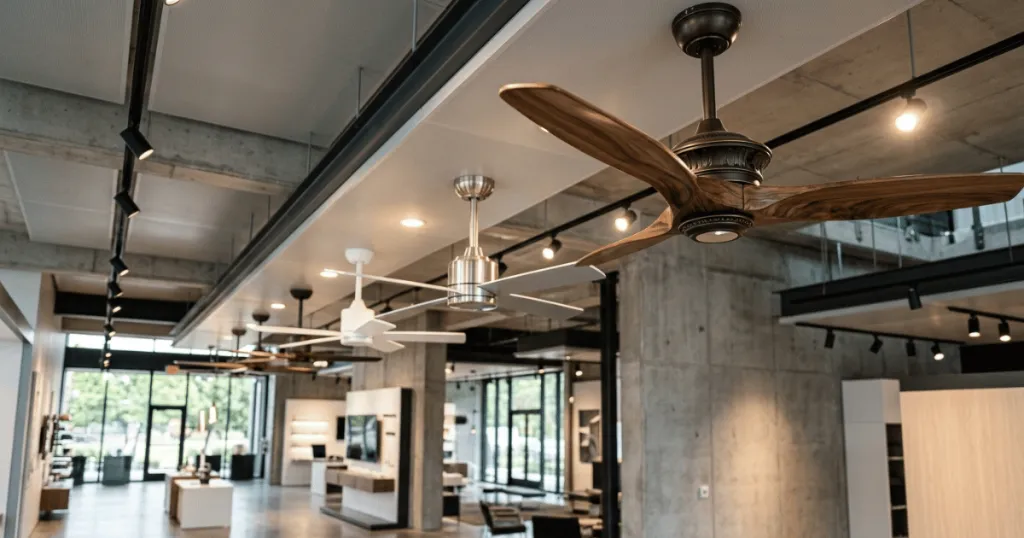
When you are shopping for a new overhead air circulator, understanding the CFM rating of a ceiling fan is the single most important technical specification to review. This metric tells you exactly how many cubic feet of air the blades move per minute.
Without looking at this specification, you risk choosing a unit that either creates an annoying wind tunnel in a small space or barely stirs the air in a large living room. By focusing on certified airflow performance rather than just blade span or visual appeal, you can ensure your living space stays comfortable throughout every season.
Evaluating air movement metrics requires looking past decorative housing finishes and lighting kits to examine the core mechanical output. Homeowners often face confusion when comparing different models because physical size does not always correlate directly with volumetric delivery. A compact unit with an optimized motor can frequently outperform a bulky alternative if its internal engineering maximizes cubic feet per minute efficiently. Knowing how to interpret these performance specifications protects you from buying an underpowered fixture for a high-volume room or an overpowered unit that disrupts papers and lightweight window treatments in a cozy study.
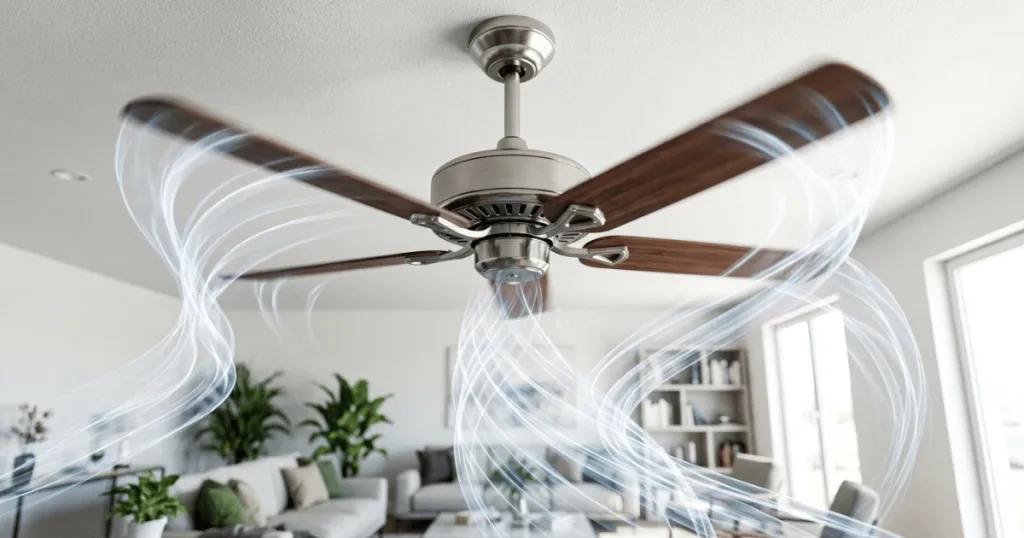
What Is a CFM Rating and How Is It Measured?
The term stands for cubic feet per minute, serving as the universal standard for measuring airflow volume. Government testing standards require manufacturers to measure how much air a model moves while operating on high speed. This testing takes place in a controlled laboratory environment using specialized equipment.
Energy information labels display these airflow numbers alongside electricity usage in watts. This gives you a clear picture of efficiency, showing how much air movement you get for every unit of electricity consumed. Higher numbers indicate stronger air delivery, while lower numbers represent gentler circulation.
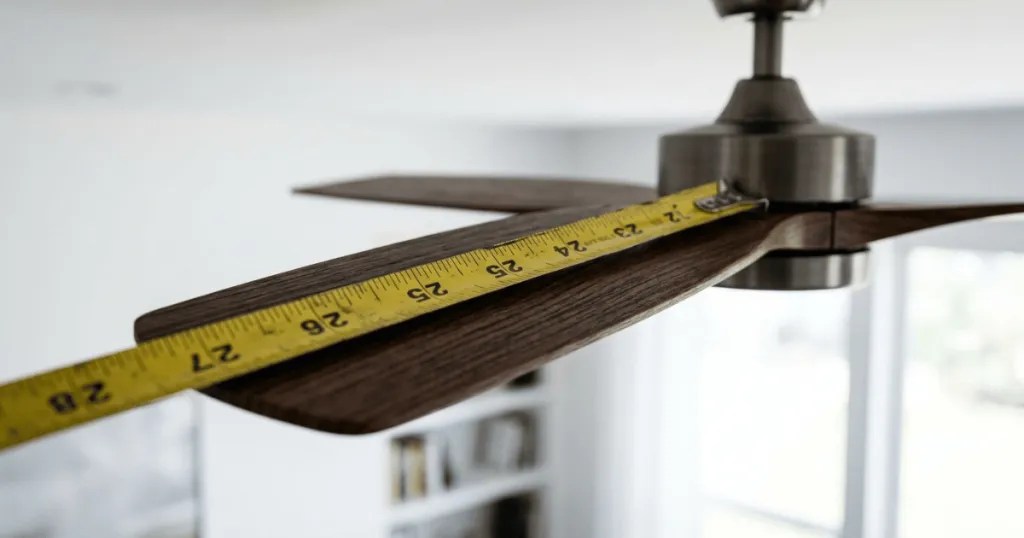
Many shoppers assume that blade span alone dictates performance, but that is a common misconception. Motor efficiency, blade pitch, and aerodynamic design play massive roles in determining the final output. Two models with identical spans can feature vastly different airflow volumes based on their internal engineering.
Standardized testing protocols ensure that every manufacturer measures cubic feet per minute under identical conditions, typically utilizing precise anemometers positioned beneath the spinning blades. However, real homes present obstacles such as sloped ceilings, furniture placement, and restricted wall clearances that can alter how the air circulates. Understanding that laboratory metrics represent ideal conditions helps you build a safety margin into your calculations, especially when outfitting irregularly shaped living spaces or rooms with heavy furnishings that impede natural airflow paths.
The Main Factors That Influence Airflow Performance
Air delivery is not random, relying instead on a precise combination of mechanical and physical variables. When evaluating different models for your home, you need to examine the core components that drive performance.
Motor Power and Efficiency
The motor serves as the core of any air circulation system. Modern brushless direct current motors spin blades with high precision while generating minimal heat. This engineering allows for exceptional energy efficiency and strong airflow across multiple speed settings.
Older alternating current motors still populate the market, often consuming more electricity to achieve comparable output. A high quality motor maintains its rotational speed even under load, ensuring consistent performance over years of daily operation.
Choosing between a DC motor and an AC motor directly impacts your utility costs and operational flexibility. DC variants typically offer six or more distinct speed settings, allowing you to fine-tune the airflow volume to match seasonal humidity and personal preference. They also run significantly quieter, which matters immensely when installed in sleeping quarters where a humming motor disrupts rest. AC units, while often lower in upfront purchase cost, usually feature only three speeds and draw more electrical current to achieve the same rotational torque.
Blade Pitch and Aerodynamics
Blade pitch refers to the angle of the blades relative to the horizontal plane. A steeper pitch scoops and pushes more air downward, but it also places a heavier load on the motor. The ideal angle usually falls between twelve and fourteen degrees for optimal balance.
Blade shape and material finish also affect performance. Curved or contoured blades slice through the air quietly, reducing turbulence and maximizing the volume pushed into the living zone below.
If a blade angle is too shallow, below twelve degrees, the blades merely slice through the air without engaging it effectively, resulting in poor volumetric output regardless of how fast the motor spins. Conversely, a pitch exceeding fifteen degrees can strain standard motors unless paired with heavy-duty windings and robust brackets. Material choice also matters significantly; stamped steel, molded ABS plastic, and solid wood each react differently to moisture and humidity over time, which can cause warping and alter the aerodynamic balance needed to maintain peak performance.
How Room Size Guides Your Airflow Requirements
Matching airflow output to your specific room dimensions prevents wasted energy and uncomfortable drafts. Small bedrooms, expansive great rooms, and covered outdoor patios all demand different performance levels.
| Room Size | Typical Square Footage | Recommended CFM Range |
|---|---|---|
| Small Room | Up to 75 sq. ft. (e.g., bathrooms, walk-in closets) | 1,000 to 3,000 |
| Medium Room | 76 to 144 sq. ft. (e.g., standard bedrooms, home offices) | 4,000 to 5,000 |
| Large Room | 144 to 300 sq. ft. (e.g., master bedrooms, family rooms) | 5,000 to 6,000+ |
| Extra Large Room | Over 300 sq. ft. (e.g., open-concept living spaces, great rooms) | 6,500 to 9,000+ |
In practice, putting a low-output model in a massive open-concept great room leaves the space feeling stagnant. Conversely, installing a heavy-duty air mover in a compact home office creates an aggressive windstorm that blows papers off your desk. Pay close attention to these volumetric benchmarks before making a final selection.
When calculating requirements for irregularly shaped rooms or spaces featuring vaulted ceilings, standard square footage calculations may fall short. An L-shaped living and dining combination often requires dual circulating fixtures to ensure proper coverage across both zones, even if the total square footage theoretically falls within the threshold of a single large unit. In these scenarios, staggering two medium-output fixtures provides superior air mixing compared to relying on one oversized motor struggling to push air around structural corners and dividing walls.
Real-World Context and Airflow Efficiency
Laboratory numbers provide a useful baseline, but real home environments introduce variables that affect actual performance. Ceiling height, vaulted spaces, and local climate all interact with your chosen fixture.
When ceilings rise above nine feet, the air has more distance to travel before reaching the living zone. In these tall rooms, selecting a model with higher airflow output becomes essential. You also need to use an appropriate downrod to drop the fan into the optimal functional zone.
Energy efficiency standards, often tracked by regulatory bodies, help you identify models that deliver high performance without inflating your monthly utility bills. High airflow efficiency means more cubic feet per minute per watt of electricity consumed. This metric rewards well-engineered motors and aerodynamic blade designs.
Climate considerations also dictate how you interpret these performance numbers. Homes situated in humid southern regions benefit greatly from higher velocity air delivery to maximize the skin evaporation rate, whereas dry desert climates require balanced circulation that does not accelerate skin dehydration. Furthermore, vaulted and cathedral ceilings trap immense blankets of heated air aloft during winter, demanding reversible motor functions capable of driving that thermal mass downward without creating cold drafts at floor level.
Why Proper Airflow Management Matters for Daily Comfort
Effective air circulation does much more than simply make a room feel breezy. It fundamentally alters how your skin experiences ambient temperature by enhancing the natural wind chill effect. This allows you to raise your thermostat setting during warm weather without sacrificing personal comfort.
During colder months, running your fixture in reverse at low speed pushes trapped warm air down from the ceiling. This thermal destratification prevents heat from wasting away unused in the upper rafters, reducing the workload on your central heating system.
Understanding these dynamics helps you maintain a balanced indoor climate year-round. It transforms an overhead fixture from a decorative accent into an active tool for managing household energy use and climate control.
Maintaining uniform indoor temperatures also prevents localized humidity pockets that foster mold growth in poorly ventilated corners. By keeping ambient air in constant, gentle motion, you eliminate stagnant microclimates within your living space. This sustained circulation protects structural finishes and wooden furnishings from extreme moisture fluctuations while ensuring every seated area enjoys equal climate benefits.
Common Misconceptions About Air Delivery Specs
Many homeowners rely on outdated assumptions when evaluating air delivery specifications. Clearing up these misunderstandings ensures you make an informed choice for your living space.
A widespread myth suggests that higher speed settings always equate to better comfort. In reality, excessively high revolutions often generate annoying wind noise and turbulence without improving overall cooling effectiveness.
Another frequent error involves ignoring wattage when evaluating airflow numbers. A model might boast impressive total output, but if it consumes an unreasonable amount of electricity to achieve it, the design lacks true efficiency. Always calculate the ratio of air movement to power consumption.
Another persistent misconception is that adding a light kit has no impact on performance. Bulky integrated lighting fixtures can disrupt the lower air column, creating turbulence that slightly reduces net volumetric delivery. Homeowners must weigh the desire for ambient overhead illumination against minor drops in aerodynamic efficiency, selecting models engineered to balance both lighting and air-moving capabilities seamlessly.
Conclusion and Next Steps for Your Selection
Evaluating the CFM rating of a ceiling fan turns guesswork into a precise science. By matching your room dimensions and ceiling height to the correct airflow volume, you guarantee lasting comfort and efficient energy use. Take time to review manufacturer specifications and energy labels before finalizing your next installation.
FAQ
What is a good CFM rating for a standard bedroom?
For a standard bedroom measuring up to 144 square feet, a rating between 4,000 and 5,000 cubic feet per minute provides ideal airflow without generating excessive noise or drafts.
Do higher speed settings always provide better performance?
Not necessarily. While maximum speed yields peak airflow numbers, operating a fan on high constantly can cause annoying wind noise and unnecessary wear. A well-designed motor should deliver comfortable circulation across multiple adjustable speeds.
How does ceiling height affect the required airflow output?
Higher ceilings require fans with greater airflow capacity and proper downrod lengths. Because air must travel a greater distance to reach the living zone, higher output ensures you still feel the cooling breeze at floor level.
Where can I find the official airflow specifications for a specific model?
Manufacturers list these technical details on the official energy information label, product specification sheet, and online retailer listings under the airflow or cubic feet per minute category.