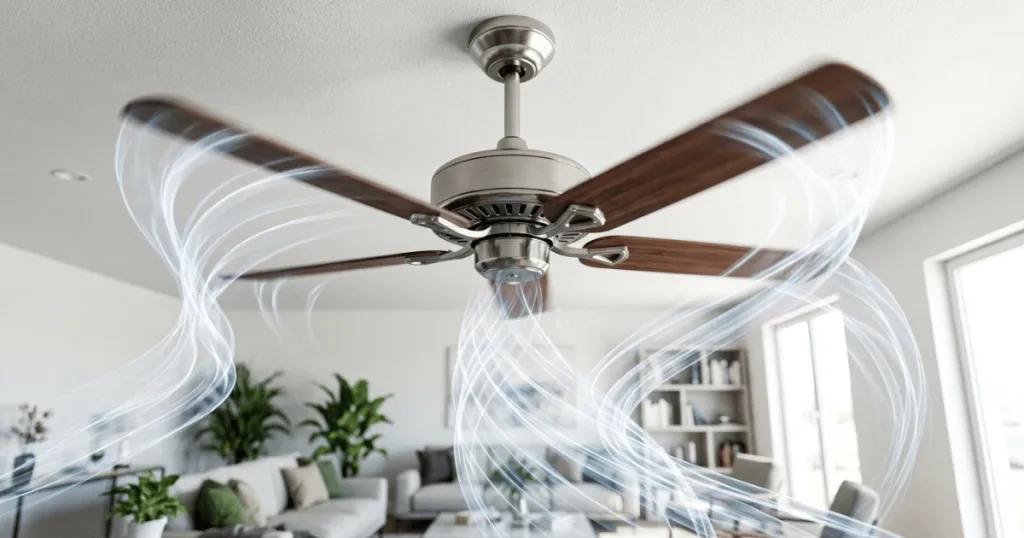
Short Answer: To choose the right ceiling fan size, calculate your room square footage and match it to a recommended blade span. Rooms up to 75 square feet need a 36-inch fan, rooms up to 144 square feet need a 42 to 48-inch fan, rooms up to 225 square feet need a 52-inch fan, and larger spaces need 60-inch fans or dual units.
Before you open a tape measure or browse fixture catalogs, run a quick readiness check on your space. Confirm that you have safe ladder access to the ceiling, a clear understanding of your room dimensions, and the patience to check your electrical junction box before installation begins. If your wiring is outdated or your ceiling shows signs of water damage, pause your fan project to address those structural issues first because a secure foundation is essential for safe operation.
Deciding how to choose ceiling fan size properly prevents the common problem of installing a fixture that either overwhelms a compact bedroom or fails to move air in a large living area. When you finish this process, you will know the exact blade span required for your specific square footage, ceiling height, and room layout. A well-proportioned fan creates comfortable air circulation without creating annoying drafts or looking disproportionate to your furniture.
Many homeowners guess at dimensions based purely on visual appeal, only to find that an undersized motor strains to cool the space or an oversized canopy dominates the ceiling. Taking accurate room measurements and understanding baseline performance metrics protects your investment and ensures daily comfort.
Before You Start Measuring Your Room
Before purchasing a new fixture, you need to gather specific room dimensions and evaluate structural constraints. Start by measuring the length and width of the space in feet, then multiply those numbers to find the total square footage. This simple calculation serves as the foundation for every sizing chart and manufacturer recommendation.
Next, check your ceiling height carefully. Standard ceilings measuring eight to nine feet accommodate standard downrods or low-profile flush mounts. Vaulted, sloped, or high ceilings exceeding ten feet require longer extension downrods to drop the blades into the effective living zone. If your ceiling is lower than eight feet, safety regulations require a low-profile or tuck-in hugger mount to maintain adequate clearance from the floor.
Evaluate your room layout and furniture placement as well. The ideal fan hangs directly in the center of the room to distribute airflow evenly across all walls. If you have architectural features like exposed beams, recessed lighting trays, or sloped rooflines, map out those clearances before selecting a specific model. Ignoring these spatial boundaries often leads to blade clipping or awkward placement that reduces performance.
Tools and Context for Fan Selection
Having the right tools ready makes the evaluation process straightforward. You will need a reliable tape measure, a notepad, a calculator, and a ladder to inspect existing junction boxes if you are replacing an older fixture. Knowing the basic terminology used by manufacturers also helps you decode specifications.
Blade span, measured as the diameter of the circle created by the spinning blades, is the primary metric for sizing. Cubic feet per minute, commonly abbreviated as CFM, measures the volume of air the motor and blade pitch move per minute. High CFM numbers indicate stronger airflow, which matters significantly in humid climates or large open-concept living spaces.
Energy efficiency and motor type also provide useful context. Modern ceiling fans typically use either traditional alternating current motors or advanced direct current motors. Direct current motors run significantly quieter, offer more speed settings, and consume less electricity, making them a practical upgrade for bedrooms where noise sensitivity matters.
Step-by-Step Instructions: How to Choose Ceiling Fan Size
Step 1: Calculate Total Room Square Footage
Measure the longest wall and the widest wall of the room using your tape measure. Multiply these two figures together to determine the total square footage of the space. For example, a bedroom measuring twelve feet by fourteen feet equals one hundred sixty-eight square feet.
If your room features an unusual shape, L-shape, or open-concept design that flows into a kitchen or hallway, treat the primary seating or living zone as its own distinct calculation area. This prevents you from undersizing the fixture for the part of the room where you actually spend your time. When assessing open-concept areas, look closely at room square footage boundaries to determine whether a single large fixture or two medium units will provide balanced ambient comfort.
Consider structural obstacles like centralized heating ducts, skylights, or heavy ceiling beams when defining your active zone. If your furniture configuration pushes your primary seating toward one corner, you may need to offset the installation slightly to ensure the direct breeze reaches occupants, while maintaining safe clearance from surrounding walls. Calculating square footage accurately requires accounting for these architectural realities rather than relying solely on exterior wall dimensions, especially in older homes with irregular room additions.
Step 2: Match Square Footage to Recommended Blade Span
Use standard industry guidelines to match your calculated square footage to the appropriate blade span diameter. For small spaces up to seventy-five square feet, such as a walk-in closet or small bathroom, a thirty-six-inch fan provides sufficient coverage. For rooms between seventy-six and one hundred forty-four square feet, like standard bedrooms or home offices, a forty-two to forty-eight-inch blade span works best.
For larger spaces ranging from one hundred forty-four to two hundred twenty-five square feet, such as master bedrooms or medium living rooms, select a fifty-two-inch fan. Spaces exceeding two hundred twenty-five square feet, including great rooms and open-concept areas, often require sixty-inch or larger fans, or a dual-fan setup to maintain proper airflow velocity. Reference a reliable ceiling fan size chart during this stage to cross-reference multiple brand standards and avoid relying on a single manufacturer recommendation.
When you encounter boundary square footages, such as a room measuring exactly one hundred forty-four square feet, lean toward the larger blade span if the room has high ceilings, poor natural ventilation, or high solar heat gain from large windows. Conversely, if the room is cluttered with tall bookcases or cabinetry that physically restricts open air pathways, a slightly smaller blade span can prevent awkward wall collisions while still providing adequate air mixing for the remaining open floor area.
Step 3: Adjust for Ceiling Height and Downrod Length
Factor your vertical clearance into the sizing equation to ensure optimal performance. The blades of a ceiling fan should hang at least seven feet above the finished floor for safety and optimal air mixing. If your ceiling measures nine feet, a standard four-inch downrod usually positions the blades at the ideal eight-foot height.
For every foot of ceiling height above nine feet, add a corresponding downrod length to maintain that optimal eight-foot blade level. Failing to lower a fan in a high-ceiling room leaves the moving air trapped near the roofline, rendering the fixture completely ineffective at floor level where you actually feel the breeze. When dealing with tall or vaulted vertical spaces, selecting the correct downrod length prevents stagnation and keeps air velocity consistent across the entire room volume.
In spaces with low ceilings measuring under eight feet, select low-profile hugger fans that mount flush against the ceiling surface. While hugger models sacrifice a small amount of airflow efficiency because the blades sit closer to the flat ceiling plane, they remain a mandatory safety choice to prevent accidental contact with household members or raised arms. Always verify that your chosen downrod is rated for the specific weight and rotational torque of your fan model, particularly when using extension rods exceeding twelve inches in length.
Step 4: Review Airflow and CFM Ratings
Examine the technical specifications of your shortlisted models to check their airflow efficiency. Look for the published CFM airflow rating and divide it by the wattage consumed by the motor to find the CFM per watt efficiency metric. Higher numbers indicate a more effective air mover that will not drive up your utility bills.
Prioritize higher CFM ratings if you live in a warm climate or if the room receives intense afternoon sunlight. Conversely, if you are installing the fixture in a quiet guest room, prioritize low operating noise and balanced motor dampening over raw maximum airflow. Always verify that the listed CFM performance matches the blade span tier you selected during your initial room measurements.
Pay close attention to blade pitch, which is the angle of the blades relative to the horizontal plane. A steeper pitch, typically ranging from twelve to fifteen degrees, moves more air volume effectively but requires a heavier, more powerful motor to prevent stalling and excess strain. Lower pitch angles around nine to ten degrees may operate quietly but often struggle to generate a satisfying cooling breeze in larger spaces, making motor quality and blade design critical factors in overall performance.
Common Mistakes to Avoid
A frequent error is choosing a fan based entirely on room length while ignoring ceiling height or total cubic volume. A massive room with a vaulted ceiling requires a completely different approach than a standard flat-ceiling room of the exact same floor area. Neglecting vertical space leads to poor air circulation.
Another mistake involves installing an oversized fan in a compact room out of a desire for maximum breeze. An oversized fan in a small bedroom creates excessive wind turbulence, produces distracting motor noise, and visually overpowers the space. Stick strictly to the recommended square footage tiers for balanced results.
Homeowners also frequently overlook the structural capacity of the ceiling junction box. Ceiling fans are heavy and experience constant rotational torque. Hanging a large fifty-two-inch fan from a standard light fixture box instead of a fan-rated brace creates a serious safety hazard and causes unbearable rattling.
Another common misstep is ignoring the functional purpose of the room when evaluating noise levels and airflow. Installing a high-speed industrial-style fan in a nursery or study often results in unwelcome background hums that disrupt sleep or concentration. Matching motor capabilities to the intended acoustic environment is just as important as matching physical blade dimensions to the square footage.
Troubleshooting Airflow and Sizing Issues
If you have already installed a fan and suspect the size is incorrect, observe its performance during peak temperature hours. If you feel no discernible breeze while standing directly underneath, the blades are likely too short, turning too slowly, or hung too high above the living zone. Lowering the unit with an extended downrod often resolves this issue without requiring a brand new purchase.
If the room feels stuffy despite a high CFM rating, check the blade direction. During summer months, blades should spin counterclockwise at medium to high speed to push air straight down and create a wind-chill cooling effect. During winter months, reversing the motor to spin clockwise at low speed pulls cool air upward and redistributes trapped warm air down along the walls.
Wobbling and excessive noise usually point to installation imbalances rather than sizing errors. Use a blade balancing kit to level the fan blades, and tighten all visible mounting screws and downrod set screws to eliminate resonant vibrations before blaming the motor size.
If troubleshooting steps do not resolve an inadequate airflow problem, evaluate whether room layout changes are restricting circulation. Tall furniture additions or room dividers can block lateral air movement, requiring you to adjust furniture positions to restore comfortable airflow throughout the active living zone.
FAQ
Can I install a large ceiling fan in a small room if I run it on low?
Installing an oversized fan in a small room is generally discouraged. Even on low speed, the large blade span can overwhelm the space visually, create turbulent air patterns, and produce more operating noise than necessary for the square footage.
How do I measure ceiling fan blade span correctly?
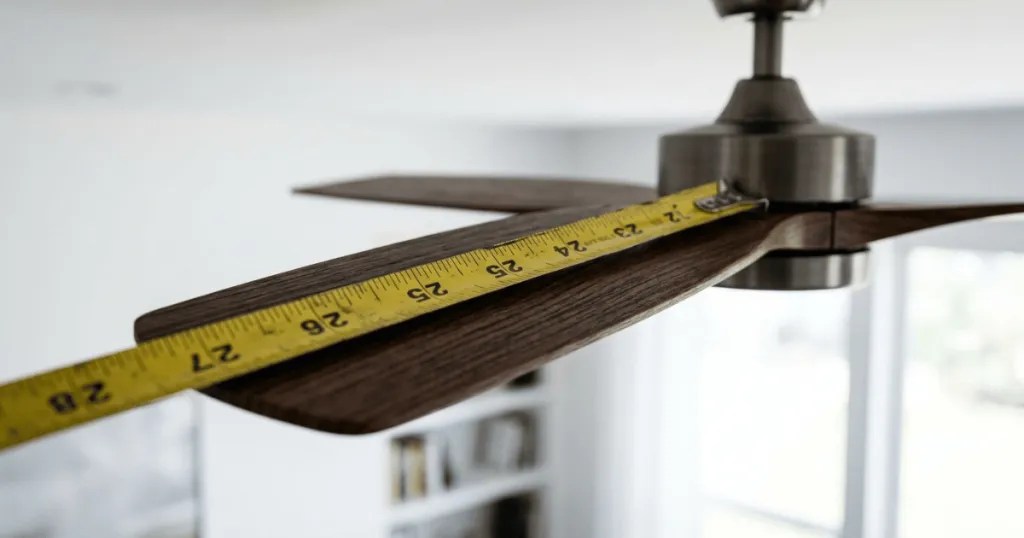
Measure the diameter of the circle created by the spinning blades by measuring from the tip of one blade straight across the center motor housing to the tip of the opposite blade. If you have an odd number of blades, measure from one blade tip to the exact center of the motor, then double that measurement.
Do vaulted ceilings require a larger fan size?
Vaulted ceilings do not necessarily require a larger blade span based on square footage alone, but they do require longer downrods to lower the fan into the active living space, along with a sloped ceiling adapter canopy to ensure proper clearance.
What is a good CFM efficiency rating for a ceiling fan?
A high-efficiency ceiling fan typically delivers over seventy-five CFM per watt at high speed. Checking this specification helps you find models that move substantial air without drawing excessive electrical current.