Key Takeaway: Most modern ceiling fan motors are factory-sealed units that cannot be repaired. If the motor itself fails, the most practical solution is to replace the entire fan. However, many issues that appear to be motor failures are actually caused by external components like capacitors, remote receivers, or wall switches, which are easily replaceable.
When your ceiling fan stops spinning or begins to hum incessantly, the immediate question is often whether the internal components can be salvaged. Homeowners frequently ask, can a ceiling fan motor be repaired, hoping for a simple fix that avoids the hassle of a full installation. The short answer is that while some electrical components are accessible, the motor housing itself is almost always a sealed, non-serviceable unit.
Understanding the distinction between a motor failure and a peripheral electrical issue is vital for any DIY enthusiast. Most modern ceiling fans are designed as integrated appliances where the motor is factory-sealed to ensure balance and safety. Attempting to open the motor casing usually voids the warranty and rarely leads to a successful, long-term fix. In most cases, if the motor has truly failed, the most practical path forward is a full unit replacement rather than an internal repair.
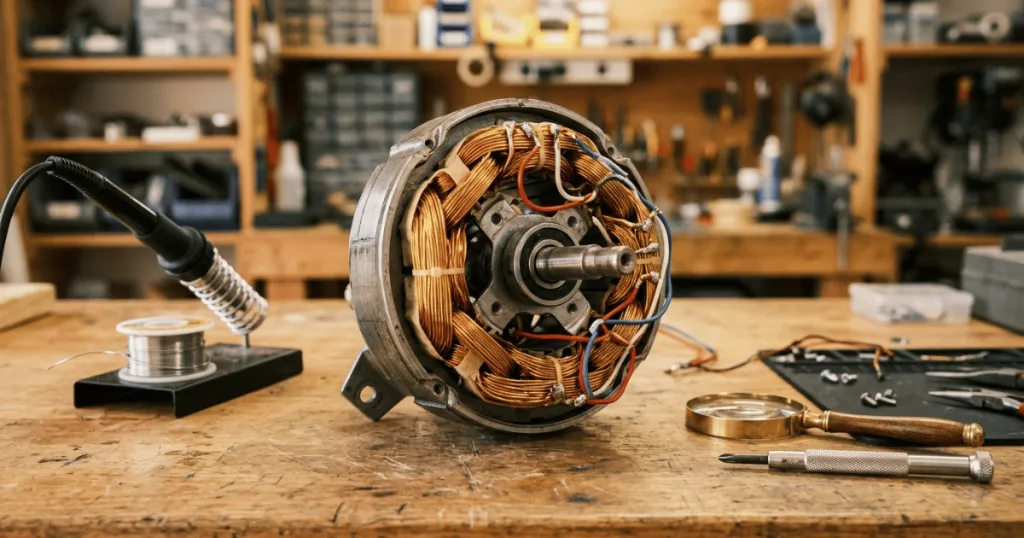
Understanding Why Motor Repair Is Rarely Practical
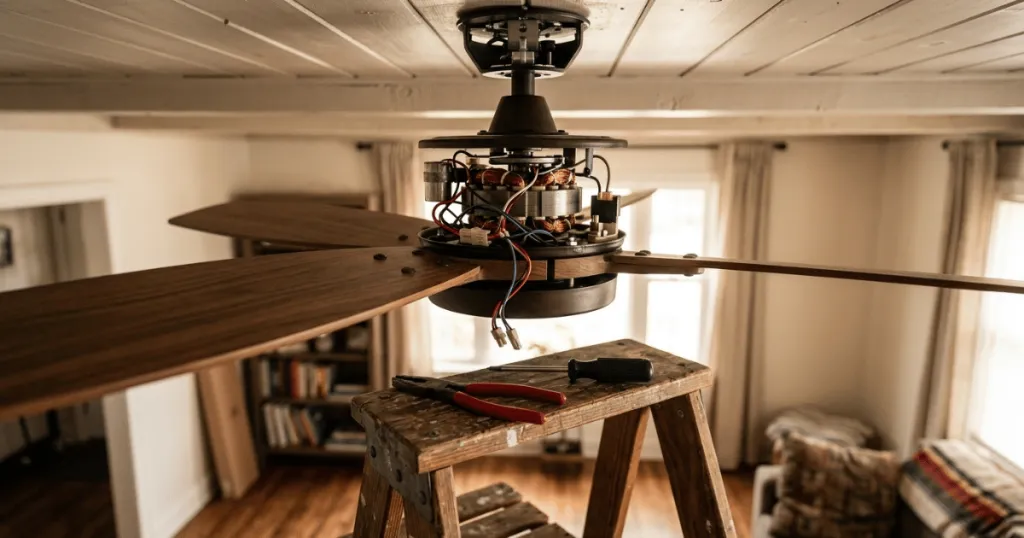
The primary reason most ceiling fan motors cannot be repaired is the manufacturing process. Manufacturers design these motors as closed systems. Once the motor is assembled at the factory, the housing is typically pressed or riveted shut. This design prevents dust and debris from entering the sensitive windings, but it also means that a homeowner cannot open the unit to replace internal capacitors, bearings, or copper wiring without specialized industrial equipment.
Even if you could physically open the motor, finding replacement parts is nearly impossible. Ceiling fan manufacturers rarely sell internal motor components like rotors, stators, or specific winding coils to the public. These parts are proprietary and specific to the exact model and production run of the fan. Without access to these parts, even a skilled technician would struggle to perform a meaningful repair.
Furthermore, the labor required to disassemble a motor housing often exceeds the cost of a new fan. Because these units are designed for mass production and low-cost replacement, the internal assembly is not meant to be serviced. Attempting to force open a riveted housing often results in permanent damage to the casing, which compromises the aerodynamic balance of the fan. A fan that is even slightly out of balance will wobble during operation, leading to premature wear on the ceiling mount and potential noise issues that are far more annoying than the original problem.
The Difference Between Motor Failure and Control Issues
It is common for homeowners to mistake a control issue for a motor failure. If your fan has stopped working, the problem might be the wall switch, the remote receiver, or the pull-chain switch rather than the motor itself. These components are external to the motor housing and are designed to be replaceable.
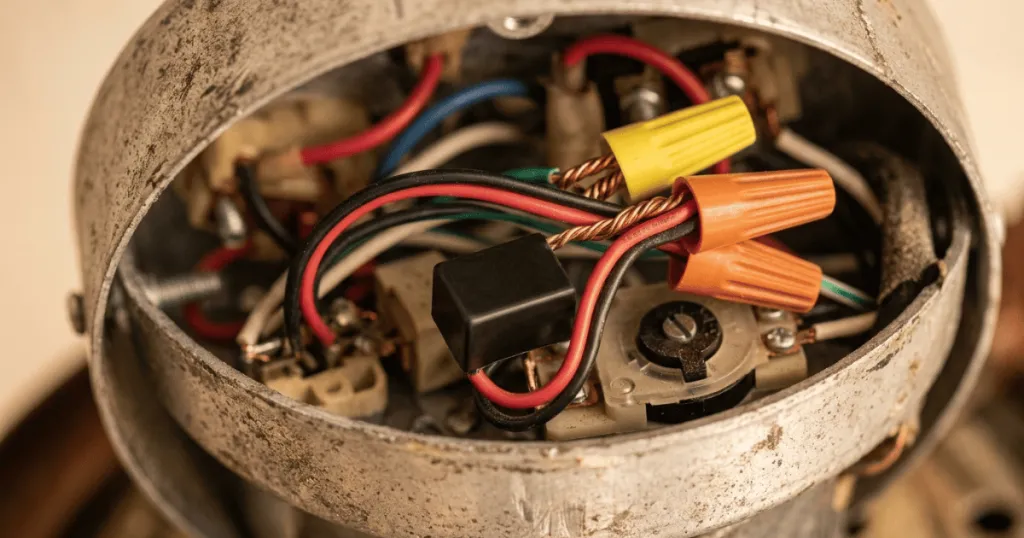
If the fan is receiving power but not moving, check the capacitor first. The capacitor is a small, cylindrical component located in the switch housing, not inside the motor itself. Replacing a faulty capacitor is a standard maintenance task that can often restore a fan to full functionality. This is the one instance where a fan can be repaired, but it is important to clarify that you are repairing the electrical starting circuit, not the motor windings.
When diagnosing, always start with the power source. Use a non-contact voltage tester to ensure electricity is reaching the fan canopy. If power is present, the next step is to inspect the remote receiver if your fan uses one. These receivers are notorious for failing due to heat buildup or power surges. Because they are modular, you can often purchase a universal replacement kit that bypasses the old, faulty unit. This is a common and effective repair that does not involve the motor at all.
Real-World Context: When to Troubleshoot vs. Replace
In a practical home setting, you should approach a non-functional fan with a clear diagnostic process. Start by ruling out the simple culprits. If the fan does not turn on, check the circuit breaker and the wall switch. If you have a remote-controlled fan, the receiver module inside the canopy is a frequent point of failure. These modules can often be bypassed or replaced with universal kits, which is a far more effective use of your time than attempting to open the motor.
Consider the age and quality of the fan when deciding your next move. High-end fans often use heavy-duty motors that are designed for longevity, but even these are not immune to eventual wear. If your fan is over ten years old, the cost of labor or the time spent sourcing parts for a potential fix often exceeds the value of a new, more efficient model. Modern fans also offer improvements in energy consumption and silent operation that older units simply cannot match.
When assessing whether to keep or replace, look at the overall condition of the fan blades and the mounting hardware. If the blades are warped, the finish is peeling, or the mounting bracket is showing signs of rust, a motor repair would be a poor investment. A ceiling fan is a holistic system. If the motor is failing, it is often a sign that the entire unit has reached the end of its useful life cycle. Replacing the fan allows you to refresh the aesthetic of the room while gaining the benefits of modern motor technology, such as DC motors that run cooler and quieter than traditional AC motors.
Noise and Wobble as Indicators
Sometimes, a fan motor is not dead but is clearly struggling. A loud grinding noise often indicates that the internal bearings have failed. While some older, industrial-style fans allowed for bearing lubrication, modern residential fans use sealed bearings that cannot be serviced. If your fan is grinding, it is a sign that the internal mechanical components are degrading. Continuing to run a fan in this state can lead to overheating and, in extreme cases, a fire hazard. At this point, the motor has reached the end of its functional life.
Wobbling is another critical indicator. While many people assume a wobble is just a balance issue, it can sometimes be a symptom of a loose motor housing or a failing internal mount. If you have already tried balancing the blades with a kit and the wobble persists, the issue likely lies within the motor assembly itself. Because the motor is a sealed unit, you cannot tighten internal components to fix this. Ignoring a persistent wobble can eventually damage the ceiling junction box, which creates a significant safety risk for your household.
Why This Matters for Your Home Comfort
The desire to repair rather than replace is understandable, especially when a fan is a central design element of a room. However, safety must remain the priority. A ceiling fan is a heavy, rotating appliance suspended above your living space. If a motor has been compromised by an amateur repair attempt, the structural integrity of the fan could be weakened. This creates a risk of the fan falling or, at the very least, becoming dangerously unbalanced.
Furthermore, energy efficiency plays a role. Older motors are often less efficient than current models. By replacing a failing fan, you are not just solving a mechanical problem; you are upgrading to a unit that likely uses less electricity and provides better airflow. This shift in perspective helps you view the replacement not as a waste, but as a necessary upgrade for your home’s comfort and safety.
Consider the environmental impact of your decision as well. While repairing is generally better for the environment, it is only true if the repair is successful and long-lasting. If you spend hours attempting to fix a motor that is fundamentally broken, you end up with a pile of electronic waste and a room that still lacks proper air circulation. Choosing a high-quality, durable fan for your next purchase is a more sustainable approach than attempting to revive a legacy motor that was never designed for longevity.
Common Misconceptions About Fan Maintenance
One of the most persistent myths is that all ceiling fans can be opened and serviced like a traditional electric motor. This stems from a time when fans were simpler, more industrial devices. Today, the focus is on aesthetics and compact design, which leads to the sealed-housing trend. Another misconception is that a humming sound is always a motor issue. Often, a hum is caused by an incompatible dimmer switch or a loose canopy connection, both of which are easily fixed without ever touching the motor.
Finally, many people believe that a professional electrician can easily repair a motor. While an electrician can diagnose the electrical supply and replace switches or receivers, they will almost universally advise against opening a motor housing. They understand that the liability and the lack of replacement parts make motor repair an unviable service. When a professional tells you the motor is shot, they are providing an honest assessment of the appliance’s condition.
Another common misconception involves the use of lubricants. Some homeowners attempt to spray lubricant into the motor housing in an effort to quiet a noisy fan. This is highly discouraged. The internal components of a ceiling fan motor are electrical in nature, and introducing oil or spray can cause short circuits, attract dust that leads to overheating, or damage the insulation on the copper windings. Always stick to external maintenance, such as cleaning the blades and checking the mounting screws, rather than attempting to lubricate the motor itself.
Strategic Decision Making for Your Ceiling Fan
When you reach the point where you must decide between a repair attempt and a replacement, evaluate the total cost of ownership. If the fan is a high-end model with a lifetime motor warranty, contact the manufacturer first. Some premium brands offer replacement motors or entire motor assemblies if the unit is still under warranty. This is the only scenario where a motor repair or replacement is truly viable.
For standard residential fans, the math is straightforward. If the cost of a replacement motor or the time spent troubleshooting exceeds the cost of a new, comparable fan, replacement is the logical choice. Remember that a new fan comes with a fresh warranty, updated safety features, and often better energy ratings. By focusing your efforts on the external components like capacitors and switches, you can resolve the vast majority of ceiling fan issues without ever needing to open the motor housing.
FAQ
Can a ceiling fan motor be repaired if it just makes a humming noise?
A humming noise is often caused by an incompatible wall dimmer or a loose electrical connection, not a failed motor. You should check your switch type and tighten all connections before assuming the motor is the problem.
Is it possible to replace the internal bearings of a ceiling fan?
In most modern residential ceiling fans, the bearings are permanently sealed inside the motor housing. They are not designed to be accessed or replaced by the homeowner, making a full unit replacement the standard solution for bearing failure.
What should I check before concluding the motor is broken?
Always test the capacitor, the remote receiver module, and the wall switch first. These external components are common points of failure that can be easily replaced to restore power to the fan.