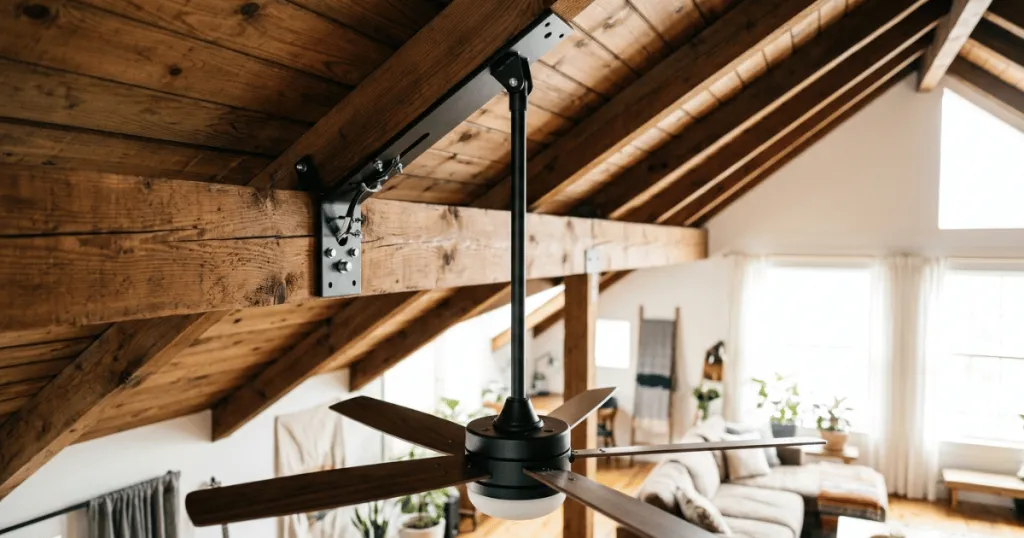
At a Glance: The choice is primarily dictated by ceiling height. Use a flush mount for ceilings 8 feet or lower to maintain safety clearance. Use a downrod for ceilings 9 feet or higher to ensure optimal airflow efficiency and performance.
When deciding between a flush mount vs downrod installation, the primary factor that should dictate your choice is your ceiling height. While aesthetics often lead the conversation, the physical distance between the fan blades and the ceiling determines both the efficiency of the airflow and the safety of the room. A flush mount, also known as a hugger fan, is designed to sit directly against the ceiling, making it the standard choice for rooms with lower ceilings. Conversely, a downrod installation suspends the fan at a specific distance, which is necessary for optimal air circulation in rooms with standard or vaulted ceilings.
Ignoring these height requirements can lead to poor performance or safety hazards. If you install a fan too close to the ceiling, the blades may struggle to pull enough air, resulting in weak circulation. If you install a fan too low in a high-traffic area, you risk accidental contact. Understanding these trade-offs ensures that your ceiling fan provides the intended comfort without compromising the room’s utility.

| Feature | Flush Mount (Hugger) | Downrod Installation |
|---|---|---|
| Best Ceiling Height | Under 8 feet | 8 feet and above |
| Airflow Efficiency | Moderate | High (Optimal) |
| Installation Complexity | Lower | Higher |
| Vaulted Ceiling Compatibility | Limited | Excellent |
| Visual Profile | Low-profile | Extended/Adjustable |
Understanding Flush Mount Ceiling Fans
Flush mount fans, frequently referred to as hugger fans, are engineered specifically for low-ceiling environments. In these models, the motor housing attaches directly to the mounting bracket on the ceiling, eliminating the gap found in traditional designs. This configuration is the most effective way to maintain necessary clearance in rooms with ceilings measuring eight feet or lower, where safety codes often mandate a minimum distance between the floor and the blades.
The primary trade-off with a flush mount is airflow performance. Because the blades are positioned very close to the ceiling, the fan motor often has a restricted intake area. This proximity can cause the blades to chop the air rather than move it efficiently, which may result in less effective cooling or air distribution compared to a fan suspended on a rod. If you are choosing a flush mount for a living room or bedroom, look for models specifically designed with angled blade pitch to compensate for this inherent limitation.
Installation of a flush mount is generally more straightforward for a DIY enthusiast because there are fewer components to manage. You do not need to worry about selecting the correct rod length or managing additional wiring extensions. However, this simplicity comes at the cost of versatility. Once a flush mount is installed, you cannot adjust its height, meaning you are locked into that specific clearance for the life of the fixture. Homeowners should also be aware that because the motor is mounted directly to the ceiling, any vibration or motor hum may be more easily transferred to the ceiling joists, potentially increasing noise levels in the room below.
Analyzing Downrod Installation
Downrod installation provides the gold standard for ceiling fan performance. By using a metal pipe to suspend the fan motor away from the ceiling, you create a dedicated space for the blades to draw air from above. This increased clearance allows the fan to move a higher volume of air with less effort, which is why downrod-mounted fans are almost always more efficient than their flush-mounted counterparts.
This mounting method is essential for rooms with standard nine-foot ceilings or higher, including cathedral or vaulted ceilings. For vaulted spaces, a downrod is the only way to ensure the fan hangs level. Most manufacturers provide downrods in various lengths, allowing you to customize the drop distance based on the exact height of your ceiling. This flexibility ensures that the fan blades sit at the ideal height—typically 8 to 9 feet from the floor—to maximize comfort for occupants.
While downrod installations offer superior performance and aesthetic balance in larger rooms, they do require more careful planning. You must calculate the correct rod length to avoid hanging the fan too low, which can make a room feel cluttered or create a safety hazard. Furthermore, installing a downrod requires additional steps, such as securing the rod to the motor housing and ensuring the canopy is properly seated, which adds a layer of complexity to the assembly process. The use of a ball-and-socket mounting bracket is common in these systems, which allows the fan to self-level even on sloped surfaces, a feature that is rarely found in flush-mount designs.
Feature-by-Feature Differences
The decision between these two mounting styles rests on three core pillars: airflow dynamics, room geometry, and installation requirements. Airflow is the most critical functional difference. A downrod allows the fan to operate in a free-air environment, which reduces motor strain and increases the effective radius of the breeze. In contrast, a flush mount is inherently restricted by the ceiling surface, which can create turbulence and reduce the total cubic feet per minute (CFM) of air moved.
Room geometry dictates the physical constraints of your choice. If you have a vaulted ceiling, a downrod is non-negotiable. You will need a sloped ceiling adapter to ensure the rod hangs vertically, keeping the fan balanced. Flush mounts are generally incompatible with sloped ceilings unless they are specifically engineered with a pivoting base, which is rare. For standard 8-foot ceilings, a flush mount is the pragmatic choice to maintain the required 7-foot clearance from the floor to the blade tips.
Installation workflows also differ significantly. A flush mount is a “one-and-done” installation where the housing is bolted to the ceiling bracket. A downrod system involves more mechanical connections, including the rod, the coupling, and the safety pin. While neither is overly difficult for a prepared homeowner, the downrod system requires more attention to detail regarding the stability of the connection. A loose downrod can lead to fan wobble, which is a common complaint in poorly installed fans. Ensuring that the mounting bracket is securely fastened to a fan-rated junction box is a critical step for both, but the leverage applied by a downrod makes the structural integrity of the box even more vital.
Evaluating Airflow Efficiency and Blade Pitch
When comparing flush mount vs downrod installation, the relationship between blade pitch and airflow is paramount. Blade pitch refers to the angle of the fan blades relative to the horizontal plane. A steeper pitch generally moves more air, but it also places a higher load on the motor. In a flush mount configuration, the limited space between the blades and the ceiling can lead to air starvation, where the fan struggles to pull air from above. Manufacturers often mitigate this by using wider blades or higher motor torque, but the physical limitation remains.
Downrod fans benefit from the “free air” effect. By dropping the fan 12 to 24 inches from the ceiling, the blades can draw air from a larger volume, resulting in a more consistent and powerful breeze. This is particularly noticeable in larger rooms where the goal is to circulate air throughout the entire space rather than just directly beneath the fan. For homeowners prioritizing cooling efficiency, the downrod is almost always the superior choice, provided the ceiling height allows for it.
The Role of Ceiling Height in Safety and Comfort
Safety is the primary constraint when choosing a mount. Building codes and manufacturer guidelines almost universally require a minimum of 7 feet of clearance between the floor and the lowest point of the fan blades. In an 8-foot ceiling room, a flush mount is the only way to meet this requirement while still allowing for a functional fan. If you were to use a 6-inch downrod in an 8-foot room, you would likely drop the blades to 6.5 feet or lower, which creates a significant safety hazard for taller individuals and makes the room feel cramped.
Conversely, in rooms with 10-foot or 12-foot ceilings, a flush mount is a poor choice. If the fan is mounted flush, the air is trapped near the ceiling, and the breeze will not reach the occupants effectively. In these cases, a longer downrod is necessary to bring the fan into the “comfort zone.” A good rule of thumb is to aim for the blades to be between 8 and 9 feet from the floor. This provides the best balance between air movement and the visual proportion of the room.
Best Use Cases for Each Mount
Flush mount fans are the clear winner for basements, older homes with low-profile architecture, and small bedrooms where ceiling height is at a premium. If your ceiling is 8 feet or lower, a flush mount prevents the “low-hanging” sensation that makes a room feel cramped. They are also excellent for minimalist design schemes where you want the fan to blend into the ceiling rather than serving as a focal point. Because they are compact, they are less likely to interfere with high-profile furniture or bunk beds.
Downrod installations are best suited for great rooms, high-ceiling living areas, and master suites with 9-foot or higher ceilings. If your goal is maximum air circulation, the downrod is the superior choice. It is also the preferred option for “statement” fans, as the extended rod allows the design of the fan to be more visible and integrated into the room’s decor. If you live in a hot climate where consistent, high-volume airflow is a daily necessity, prioritize a downrod installation whenever your ceiling height allows it. The added flexibility of selecting a custom downrod length allows you to fine-tune the fan’s position to match the specific needs of your room’s layout.
Which One Should You Choose?
Choosing between flush mount vs downrod installation should be a binary decision based on your ceiling height. If your ceiling is 8 feet or lower, you must choose a flush mount to comply with basic safety standards and to prevent the room from feeling claustrophobic. Do not attempt to force a downrod into a low-ceiling room; the risk of head contact is too high, and the fan will likely be positioned too close to the occupants for comfort.
If your ceiling is 9 feet or higher, the downrod is the correct choice in almost every scenario. It provides the necessary space for the blades to function at their peak efficiency. If you are worried about the look of a long rod, remember that downrods come in various lengths, including short 3-inch or 6-inch options that provide the benefits of a downrod without an excessive drop. Professionals generally prioritize the downrod for its longevity and performance, as the motor is less prone to the heat buildup that can occur in some flush-mount configurations.
Ultimately, the “better” option is the one that fits your space’s physical dimensions. If you are still unsure, measure the distance from your ceiling to the floor. Subtract 7 feet from that total; the remaining number is the maximum length of the fan assembly you should consider. If that number is very small, stick to a flush mount. If you have plenty of room, choose a downrod and select a rod length that brings the fan blades to the 8-to-9-foot range above the floor. This systematic approach ensures you achieve the best possible balance of safety, aesthetics, and cooling performance for your home.
FAQ
Can I convert a downrod fan to a flush mount?
Most ceiling fans are designed specifically for one type of installation. While some models are ‘dual-mount’ and include parts for both, you cannot safely convert a dedicated downrod fan into a flush mount without manufacturer-approved parts, as the motor housing and mounting bracket are structurally different.
Does a flush mount fan move less air?
Generally, yes. Because the blades are positioned close to the ceiling, the intake area is restricted, which can reduce the total volume of air moved compared to a fan suspended on a downrod. However, high-quality flush mounts with optimized blade pitch can still provide effective cooling for smaller rooms.
What is the minimum ceiling height for a downrod?
For safety, the blades of a ceiling fan should be at least 7 feet above the floor. If your ceiling is 8 feet high, a downrod would likely place the blades too close to the floor, making a flush mount the only safe and practical choice.