Short Answer: No, ceiling fans are not expensive to run. They typically consume between 15 and 90 watts of electricity, which translates to only a few dollars per month even with consistent use. Their primary value lies in their ability to create a wind chill effect, allowing you to raise your thermostat setting and reduce the workload on your central air conditioning system.
When homeowners look for ways to cut utility bills during hot weather, they often wonder whether keeping cooling fixtures running all day adds up quickly. If you are asking yourself, are ceiling fans expensive to run, the short answer is that they are remarkably inexpensive to operate compared to almost any other climate control appliance in a home. Modern models use very little electricity, turning a modest amount of power into significant air movement that keeps rooms comfortable without driving up utility bills.
Understanding the true financial impact requires looking beyond the basic appliance purchase price to examine everyday power consumption, motor efficiency, and how these devices interact with your home heating and cooling systems. When used correctly, a standard ceiling fan can actually lower your overall energy expenditure by reducing your reliance on central air conditioning.
Breaking Down the Electricity Consumption of Ceiling Fans
To understand the financial reality of running these fixtures, we need to look at how much power they actually draw from your home electrical system. Unlike refrigerators or central air conditioners that demand thousands of watts, standard ceiling fans operate on surprisingly modest amounts of energy. A typical residential unit consumes anywhere from 15 to 90 watts depending on its size, age, and motor technology.
Older models with traditional alternating current motors tend to sit at the higher end of that wattage spectrum, particularly when running on high speed. Newer units equipped with direct current motors pull significantly less power, often using less than 30 watts even at maximum output. Because electricity rates are billed in kilowatt-hours, running a typical fan for hours at a time amounts to a fraction of a cent per hour in most regions.
To put this into perspective, running a 60-watt fan continuously for ten hours uses about 0.6 kilowatt-hours of electricity. At an average utility rate across the United States, that operation costs less than a single dime for the entire day. Even if you leave a fan running in an empty room by mistake, the financial penalty is negligible compared to leaving a central air conditioning unit running.
When evaluating the cost, it is helpful to consider the total load of your home. If you have several fans running simultaneously, the cumulative effect remains low. For instance, operating four fans at 40 watts each results in a total draw of 160 watts, which is still less than the power required by a single standard incandescent light bulb from years past. This low consumption profile makes ceiling fans one of the most efficient tools for managing indoor comfort without significant financial strain.
Key Factors That Influence Your Monthly Cooling Costs
While the baseline electricity draw is low, several real-world variables influence how much running a ceiling fan actually costs over a billing cycle. Motor efficiency, daily runtime habits, and the specific size of the room all play a role in determining your final utility expenses.
AC Versus DC Motor Technology
The type of motor inside the housing is the single biggest determinant of electrical draw. Traditional alternating current motors are reliable and common in older homes, but they are less efficient at converting electrical current into mechanical rotation. Direct current motors have transformed modern ceiling fan engineering by using internal magnets to reduce electrical resistance.
A direct current motor typically uses up to 70 percent less electricity than a comparable alternating current model while offering quieter operation and finer speed control. If you are replacing an aging fixture, upgrading to a direct current model yields immediate electricity savings that compound over years of daily use. Beyond the raw wattage, these motors often provide smoother acceleration and more consistent airflow, which improves the overall user experience without increasing the cost of operation.
Speed Settings and Airflow Delivery
Operating a fixture on its highest setting draws more power than running it on medium or low. However, the increase in electrical draw between speeds is generally linear rather than exponential. Even on high, the total wattage remains low enough that energy costs stay minimal.
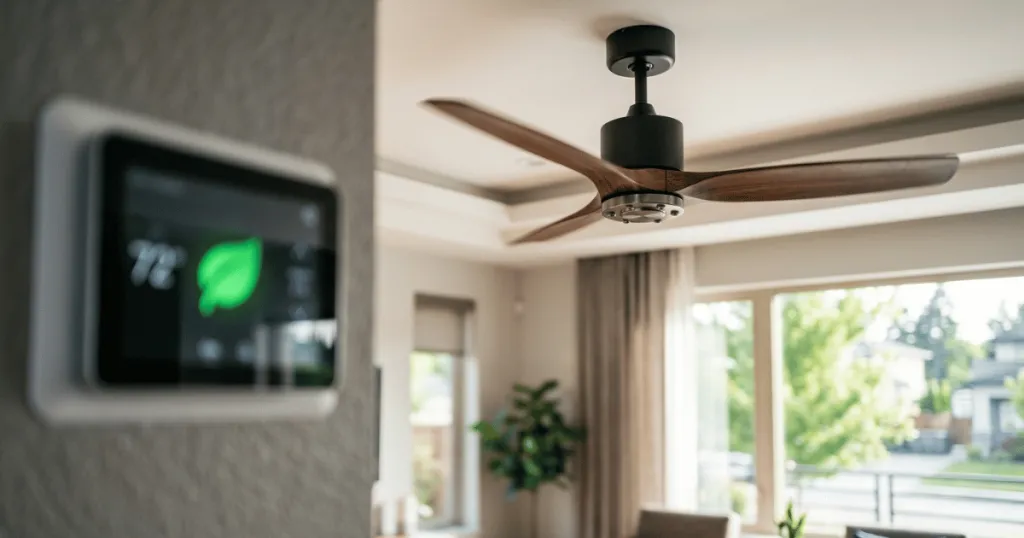
The real efficiency factor here is occupant comfort. A high-velocity airflow creates a strong wind chill effect on human skin, making you feel several degrees cooler than the actual room temperature. This subjective cooling effect allows you to raise your thermostat setting by a few degrees without sacrificing comfort, which delivers massive savings on your central air conditioning bill. It is important to note that the perceived cooling effect is highly dependent on the blade pitch and the distance of the fan from the floor. A fan that is too high or has blades that are too flat may not provide the necessary air movement to justify a thermostat adjustment.
Daily Runtime and Usage Habits
How many hours a day the blades spin dictates your monthly total. Many households leave units running continuously in occupied rooms, while others turn them off the moment they walk away. Because the hourly cost is fractions of a penny, letting a fan run in an occupied living space all day adds only a few dollars to your monthly bill.
However, running a fan in an empty room provides zero cooling benefit because these fixtures cool people, not empty spaces. Developing the habit of turning off fixtures when leaving a room is a smart practice, though forgetting to do so will not shock you when the utility bill arrives. Homeowners should also consider the use of wall controls or remote systems that include timers, as these can automate the process and ensure that energy is not wasted when a room is unoccupied for long periods.
Real-World Scenarios and Practical Savings
To see how these numbers play out in daily life, consider a standard suburban home during the peak of summer. The central air conditioning system cycles on and off throughout the day, consuming thousands of watts to cool the entire house. Meanwhile, a bedroom features a modern 50-watt ceiling fan spinning on medium speed.
By keeping the air circulating, the occupants feel comfortable at a warmer ambient temperature, allowing the central air conditioning system to run for significantly shorter intervals. The small electricity cost of the fan is easily offset by the reduction in compressor runtime from the central cooling system. In practice, this synergy between air circulation and climate control is where the real financial benefit lies.
Consider another common scenario involving seasonal operation. During the winter months, reversing the direction of the blades at a low speed pushes warm air down from the ceiling without creating a chilling draft. This helps distribute heat evenly through living spaces, reducing the workload on your furnace and preventing wasted energy trapped near high ceilings. This technique is particularly effective in rooms with vaulted or high ceilings where heat stratification is a common issue. By gently pushing the warm air down, you can maintain a more uniform temperature throughout the room, which often allows the thermostat to reach its set point faster and cycle off sooner.
Why Efficient Air Circulation Matters for Your Budget
Looking at utility costs in isolation misses the broader picture of home energy management. The primary financial value of a ceiling fan is its ability to modify your perceived temperature rather than changing the actual heat content of the air. This distinction is vital for anyone trying to manage monthly expenses.
Every degree you lower your thermostat increases your central cooling electricity use by a noticeable percentage. By using a fan to create a localized breeze, you can bridge the gap between a warm room and a comfortable one without touching the thermostat. This operational synergy protects your household budget from the steep electricity spikes associated with heavy air conditioner use.
Furthermore, investing in quality fixtures with efficient motors pays dividends over time. While cheaper models might save a few dollars upfront, an inefficient motor wastes electricity year after year. Evaluating the long-term electrical draw helps homeowners make sound purchasing decisions that align with sustainable household management. When selecting a fan, look for models that are rated for high airflow efficiency, which is often measured in cubic feet per minute per watt. This metric provides a clear indication of how much air the fan moves relative to the electricity it consumes, allowing you to prioritize performance and economy simultaneously.
Common Misconceptions About Ceiling Fan Energy Use
Several persistent myths surround how these fixtures consume power and interact with home environments. Clearing up these misunderstandings helps homeowners use their cooling equipment more effectively.
The most widespread myth is that leaving a fan running when nobody is in the room cools the space down for later. As mentioned earlier, fans cool human skin through evaporation, not by lowering the ambient room temperature. Leaving a fixture running in an empty room wastes electricity, even if that waste amounts to only a few cents per day.
Another common misconception is that all fans consume roughly the same amount of electricity. In reality, older large-diameter models or units with heavy, decorative blade designs can pull significantly more power than streamlined modern units. Checking the manufacturer specifications for wattage ratings before purchasing or running a fixture prevents unpleasant surprises.
Finally, some people believe that running a fan and an air conditioner simultaneously cancels out any savings. In practice, running them together is an energy-saving strategy, provided you adjust your thermostat upward to compensate for the cooling breeze delivered by the blades. This integrated approach to home comfort is the most effective way to balance personal preference with energy conservation goals. By understanding the relationship between airflow, thermostat settings, and motor efficiency, you can maintain a comfortable home environment while keeping your utility costs under control.
Are ceiling fans expensive to run? Absolutely not. By combining low wattage draws with smart thermostat management, these fixtures remain one of the most cost-effective comfort investments in any home. Whether you are looking to reduce your reliance on air conditioning during the summer or improve heat distribution during the winter, a ceiling fan provides a practical and efficient solution that fits well within the budget of any homeowner.
FAQ
How much does it cost to run a ceiling fan 24 hours a day?
Running a typical 50-watt ceiling fan continuously for 24 hours uses about 1.2 kilowatt-hours of electricity. At average utility rates, this costs roughly 15 to 20 cents per day, or about five to six dollars per month.
Do ceiling fans actually cool a room down?
Ceiling fans do not lower the actual ambient temperature of a room. Instead, they create a wind chill effect that evaporates moisture on human skin, making you feel several degrees cooler than the thermometer reads.
Should I leave my ceiling fan on when I leave the room?
You should turn off ceiling fans when leaving a room. Because they cool people through air movement rather than cooling the air itself, running them in an empty space wastes electricity.